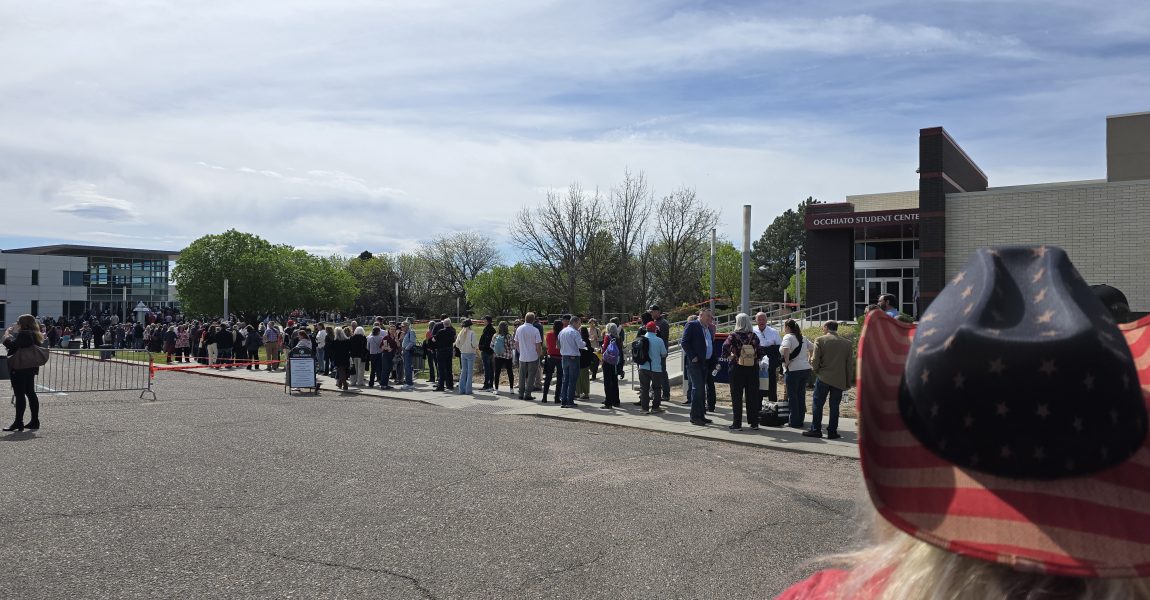
The Colorado Republican State Assembly took place on Saturday, April 11, 2026, at CSU Pueblo’s Massari Arena in Pueblo, Colorado. Over 2,000 delegates gathered to vote on which candidates would earn designation for the June 30, 2026, Republican primary ballot (via the assembly process, requiring at least 30% support in most races).
coloradopolitics.com
The event drew significant criticism and was widely described as chaotic, disorganized, and reflective of deeper internal party divisions. Here’s a breakdown of the main issues reported:1. Major Logistical and Organizational Problems
- Long delays and lines: Credentialing/registration for ~2,000 delegates started around 7 a.m. but took hours. Lines stretched for over four hours around the arena, causing the event to start five hours late (voting and proceedings dragged well into the night).
facebook.com
- Voting and counting delays: Paper ballots were used and counted by machine, which slowed the process further. Results were not finalized until very late.
coloradosun.com
2. Ballot/Vote Discrepancy (Election Integrity Concerns)
- Officials discovered about 80 more paper ballots were cast than there were credentialed delegates (some reports said ~87 extra votes). This was attributed to an error in the credentialing system.
- Delegates ultimately agreed to count the extra ballots rather than redo the voting, but it sparked criticism and questions about the party’s ability to manage even its own processes (especially ironic for a party emphasizing election integrity).
facebook.com
- Some attendees and commentators called it a “circus” or highlighted it as poor execution by party leadership.
3. Internal Infighting, Name-Calling, and Censures
- Public rancor, disagreements, and “name calling” occurred throughout the day.
- Delegates voted to censure 15 State Executive Committee members (including former or current leaders like Christy Fedura and Brita Horn). This passed overwhelmingly and highlighted ongoing leadership conflicts.
facebook.com
- Pueblo County Republican Chair Michelle Gray faced controversy, with accusations of being an “unethical liar” from incumbent Rep. Stephanie Luck (who had backed out of a race).
- Broader context: The state party had recent resignations (e.g., state chair Brita Horn and vice chair Richard Holtorf), financial troubles (loans taken out), and public disputes.
facebook.com
4. Other Notable Issues
- No-shows: Of 32 expected candidates, six did not appear.
- Candidate dynamics: In the crowded gubernatorial race (18 candidates declared, only 11 showed up to speak), only Scott Bottoms (45.13%) and Victor Marx (39.02%) cleared the 30% threshold for assembly designation. Other races saw clearer outcomes (e.g., strong support for candidates like Mark Baisley for U.S. Senate, Michael Allen for Attorney General).
- Some delegates attempted (but failed) to force an investigation into the delays.
- The atmosphere reflected “entrenched divides” within the party, with moments of public confusion and tension.
cpr.org
Despite the problems, the assembly successfully designated candidates for the primary ballot, and some attendees highlighted energetic speeches (e.g., from Lauren Boebert and others). However, media and participant accounts largely focused on the dysfunction, with descriptions like “the worst assembly ever” or a “circus” circulating afterward.
facebook.com
The issues amplified existing criticisms of Colorado GOP leadership and organization heading into the 2026 midterms, where Democrats currently hold all statewide offices.
The Colorado Republican State Assembly took place on Saturday, April 11, 2026, at CSU Pueblo’s Massari Arena in Pueblo, Colorado. Over 2,000 delegates gathered to vote on which candidates would earn designation for the June 30, 2026, Republican primary ballot (via the assembly process, requiring at least 30% support in most races).
coloradopolitics.com
The event drew significant criticism and was widely described as chaotic, disorganized, and reflective of deeper internal party divisions. Here’s a breakdown of the main issues reported:1. Major Logistical and Organizational Problems
- Long delays and lines: Credentialing/registration for ~2,000 delegates started around 7 a.m. but took hours. Lines stretched for over four hours around the arena, causing the event to start five hours late (voting and proceedings dragged well into the night).
facebook.com
- Voting and counting delays: Paper ballots were used and counted by machine, which slowed the process further. Results were not finalized until very late.
coloradosun.com
2. Ballot/Vote Discrepancy (Election Integrity Concerns)
- Officials discovered about 80 more paper ballots were cast than there were credentialed delegates (some reports said ~87 extra votes). This was attributed to an error in the credentialing system.
- Delegates ultimately agreed to count the extra ballots rather than redo the voting, but it sparked criticism and questions about the party’s ability to manage even its own processes (especially ironic for a party emphasizing election integrity).
facebook.com
- Some attendees and commentators called it a “circus” or highlighted it as poor execution by party leadership.
3. Internal Infighting, Name-Calling, and Censures
- Public rancor, disagreements, and “name calling” occurred throughout the day.
- Delegates voted to censure 15 State Executive Committee members (including former or current leaders like Christy Fedura and Brita Horn). This passed overwhelmingly and highlighted ongoing leadership conflicts.
facebook.com
- Pueblo County Republican Chair Michelle Gray faced controversy, with accusations of being an “unethical liar” from incumbent Rep. Stephanie Luck (who had backed out of a race).
- Broader context: The state party had recent resignations (e.g., state chair Brita Horn and vice chair Richard Holtorf), financial troubles (loans taken out), and public disputes.
facebook.com
4. Other Notable Issues
- No-shows: Of 32 expected candidates, six did not appear.
- Candidate dynamics: In the crowded gubernatorial race (18 candidates declared, only 11 showed up to speak), only Scott Bottoms (45.13%) and Victor Marx (39.02%) cleared the 30% threshold for assembly designation. Other races saw clearer outcomes (e.g., strong support for candidates like Mark Baisley for U.S. Senate, Michael Allen for Attorney General).
- Some delegates attempted (but failed) to force an investigation into the delays.
- The atmosphere reflected “entrenched divides” within the party, with moments of public confusion and tension.
cpr.org
Despite the problems, the assembly successfully designated candidates for the primary ballot, and some attendees highlighted energetic speeches (e.g., from Lauren Boebert and others). However, media and participant accounts largely focused on the dysfunction, with descriptions like “the worst assembly ever” or a “circus” circulating afterward.
facebook.com
The issues amplified existing criticisms of Colorado GOP leadership and organization heading into the 2026 midterms, where Democrats currently hold all statewide offices.
Key Outcomes from the Assembly Delegates designated candidates for the June 30, 2026, primary ballot (needing ≥30% support in most races):
- Governor (open seat, Jared Polis term-limited): State Rep. Scott Bottoms (pastor, one of the most conservative legislators) earned top-line with ~45%. Victor Marx (ministry leader) got ~39%. Both cleared the threshold. A more moderate contender, State Sen. Barb Kirkmeyer, skipped the assembly and is pursuing the ballot via petition signatures (status pending validation).
- U.S. Senate (challenging incumbent Sen. John Hickenlooper or the Democratic nominee): State Sen. Mark Baisley won designation with ~46% as the sole assembly qualifier.
- Other statewide races saw clearer or narrower fields (e.g., Attorney General, Secretary of State).
Negative Impacts on 2026 Prospects
- Reinforced Image of Dysfunction
Media and even some Republicans widely labeled the event a “circus,” “disaster,” or “worst assembly ever” due to hours-long credentialing lines, a 4–5 hour late start, vote-counting delays, ~80–90 extra ballots (overvote from credentialing errors), public name-calling, and a vote to censure 15 state executive committee members. This played into Democratic narratives of Republican incompetence and provided fresh ammunition for opponents to question the party’s ability to run elections or govern—especially ironic given the GOP’s emphasis on election integrity. - Nominee Selection and Electability Concerns
The gubernatorial designees (Bottoms and Marx) are described as far-right or extreme conservative pastors with limited governing experience. Analysts and opinion pieces argue they have “little chance” of winning statewide in November against a strong Democratic nominee (likely U.S. Sen. Michael Bennet or Attorney General Phil Weiser). A primary fight against the more moderate Kirkmeyer could further highlight internal rifts.
Commentators noted the party appears to favor ideological purity over broad appeal, potentially alienating moderate and unaffiliated voters who dominate Colorado’s open primary and general elections. Similar concerns apply to other races where hardline candidates advanced. - Ongoing Party Weaknesses Highlighted
The chaos occurred against a backdrop of recent leadership turmoil (e.g., state chair resignation after no-confidence vote), financial struggles (party “in the red”), lawsuits, and a shrinking base of competitive statewide candidates. It did little to project unity or professionalism heading into midterms where Republicans hope to build on modest 2024 legislative gains (narrowing the Democratic House majority). - Missed Opportunity for Momentum
Pueblo was chosen strategically as a battleground county that has flipped in recent presidential races. Both parties held assemblies there in 2026 to court voters amid affordability concerns. The GOP event’s disarray contrasted with a smoother Democratic assembly weeks earlier, potentially hurting Republican messaging and volunteer enthusiasm in a key area.
Potential Positive or Neutral Effects
- Grassroots Energy: Many attendees remained enthusiastic about the candidates and the party’s direction, seeing the designations as a win for conservative voices. Some viewed the event as reflective of a committed base energized by national trends.
- Primary Process Intact: The assembly fulfilled its role in narrowing the field without derailing the June primary. Kirkmeyer’s petition path keeps a moderate option alive in the governor’s race.
- Limited Broader Reach: In a heavily Democratic-leaning state (D+6 partisan lean, no Republican statewide win since 2016), the assembly’s issues are unlikely to be decisive on their own. Republicans’ real hurdles remain structural: voter registration gaps, Democratic fundraising advantages, and the open primary system that dilutes conservative turnout.
Overall 2026 Outlook Post-Assembly Analysts describe the cycle as bleak for Colorado Republicans at the statewide level. Democrats are favored to hold the governorship, Senate seat, and other offices, with potential to expand legislative majorities. Republicans may focus gains on targeted legislative districts or local races, but the assembly fallout has made it harder to present a unified, electable front. The event fits a longer pattern of internal challenges rather than creating entirely new obstacles. Success in November will depend more on national political winds, candidate fundraising/appeal in the primary, and whether the party can overcome its organizational deficits than on one day’s chaos in Pueblo. Coverage from outlets like CPR, Axios, Colorado Politics, and the Denver Post has framed it as another symptom of a party struggling for relevance in a blue-trending state.