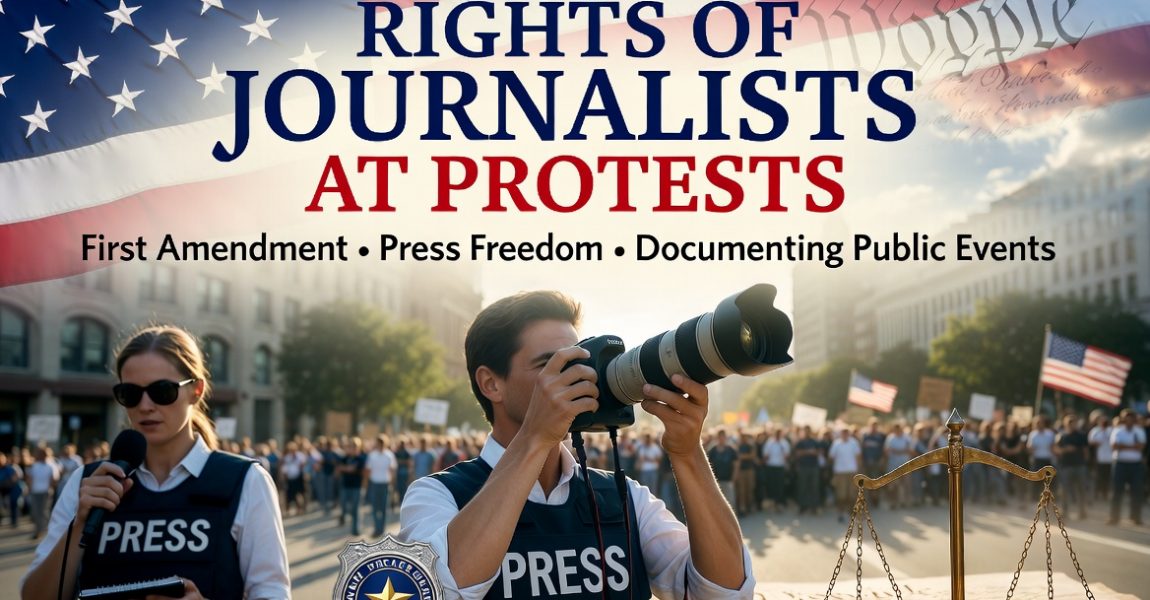
Journalists covering protests in the U.S. have strong First Amendment protections to observe, record, photograph, and report on events in public spaces, including the actions of protesters and law enforcement. These rights stem from freedom of speech and of the press, but they are not absolute. Journalists have the same core rights as the general public—no special exemptions from generally applicable laws—and must comply with valid time, place, and manner restrictions, dispersal orders, or safety directives.
rcfp.org This is general information based on federal constitutional principles and guidance from the Reporters Committee for Freedom of the Press (RCFP, updated 2025), Committee to Protect Journalists (CPJ), and related legal resources. Laws and enforcement vary by jurisdiction (state, city, federal vs. local police). This is not legal advice—consult an attorney or RCFP’s Legal Hotline (1-800-336-4243) for specific situations. Key Rights
- Access public spaces and gather news: You can be in traditional public forums (streets, sidewalks, parks) to report. Police cannot exclude you simply to prevent coverage or in retaliation for your reporting (or perceived viewpoint). rcfp.org
- Record and photograph: Most federal appeals courts recognize a First Amendment right to openly record police and public events in plain view, as long as you do not interfere with law enforcement. This applies to video, audio, and photos. You can often record from a safe distance. rcfp.org
- Report freely: Publish or disseminate what you gather, subject to general laws (e.g., no defamation, no revealing classified info in certain contexts).
- Press credentials: Visible credentials (press pass, “PRESS” markings) help identify you but do not grant absolute immunity. Some jurisdictions issue police press IDs that may allow crossing lines at officer discretion.
Major Limitations and What You Cannot Do
- Obey lawful orders: You must comply with valid dispersal orders, curfews, or movement directives if they are content-neutral, narrowly tailored for safety/traffic, and leave alternative channels open. Failure to disperse after proper notice (clear instructions, time to comply, exit route) can lead to arrest. cpj.org
- No trespassing or interference: Stay out of private property, restricted areas, or zones where the public is barred. Do not physically obstruct officers or endanger safety.
- No special access: You have no greater right than the public to crime scenes, private events, or areas closed for legitimate reasons. Permits may be required for large setups (e.g., sound equipment).
- Recording rules: Avoid secret recordings that violate state wiretapping laws (check one-party vs. all-party consent). Some states have “buffer zone” laws limiting proximity to officers (constitutionality varies).
- Violence or illegal acts: You cannot engage in or incite violence, vandalism, etc., even while reporting.
Note: Some cities/states exempt identifiable journalists from certain dispersal or curfew orders. Federal agents (e.g., DHS) may operate under different protocols. If Stopped, Detained, or Arrested
- Stay calm and visible: Keep hands visible, do not resist physically.
- Identify yourself: Politely state you are a journalist covering the event and show credentials. Continue recording if safe (audio/video of the interaction is protected in public).
- Ask clarifying questions: “Am I free to leave?” or “Am I being detained?” If not detained, you can often walk away.
- Searches and seizures: Do not consent to searches. Police need probable cause or a warrant for most searches of your person/equipment. During a lawful arrest, limited searches are allowed, but the Privacy Protection Act offers extra safeguards for journalistic work product (notes, footage intended for dissemination)—it generally cannot be searched/seized without a warrant if unrelated to your own crime. rcfp.org
- Phone/equipment: Officers generally cannot view contents without a warrant. They may seize devices incident to arrest but should not delete data.
- After arrest: You have the right to remain silent (beyond basic ID info). Request a lawyer, editor, or RCFP hotline. Charges are often later dropped if the arrest was retaliatory or lacked probable cause.
- Document everything: Note badge numbers, agency, witnesses. Retaliatory arrests or excessive force can lead to civil lawsuits.
Practical Tips for Safety and Protection
- Prepare: Carry hard-copy credentials/ID, lawyer/hotline numbers (on paper), cash for potential bond, and a backup plan/witness.
- Maintain neutrality: Avoid joining chants, wearing partisan gear, or interfering.
- Live-stream or upload footage promptly to protect it.
- Know local rules: Check permits, curfews, or protest zones in advance.
- Organizations for support: RCFP, ACLU, CPJ, local press clubs.
Journalists play a critical role in documenting public events, and courts have increasingly recognized protections against interference. However, real-world enforcement can be challenging—many incidents result in temporary arrests or equipment seizures later resolved in favor of the press. Prioritize de-escalation and safety. For the latest, visit rcfp.org or cpj.org. Stay informed and report responsibly.