
What Would a Democratic Supermajority Mean for Colorado? Understanding the Power, the Possibilities and the Limits
COLORADO — October 7, 2026 — Colorado voters will decide more than which candidates represent them in the state legislature this November. The election could determine whether Democrats gain enough seats to establish a supermajority in both chambers of the Colorado General Assembly, potentially changing how laws are passed, how gubernatorial vetoes are handled and how constitutional amendments reach voters.
But what exactly is a supermajority, and what would it mean for everyday Coloradans?
The answer involves everything from taxes and education to gun laws, government spending and the balance of political power.
What Is a Supermajority?
A supermajority occurs when one political party controls at least two-thirds of the seats in a legislative chamber.
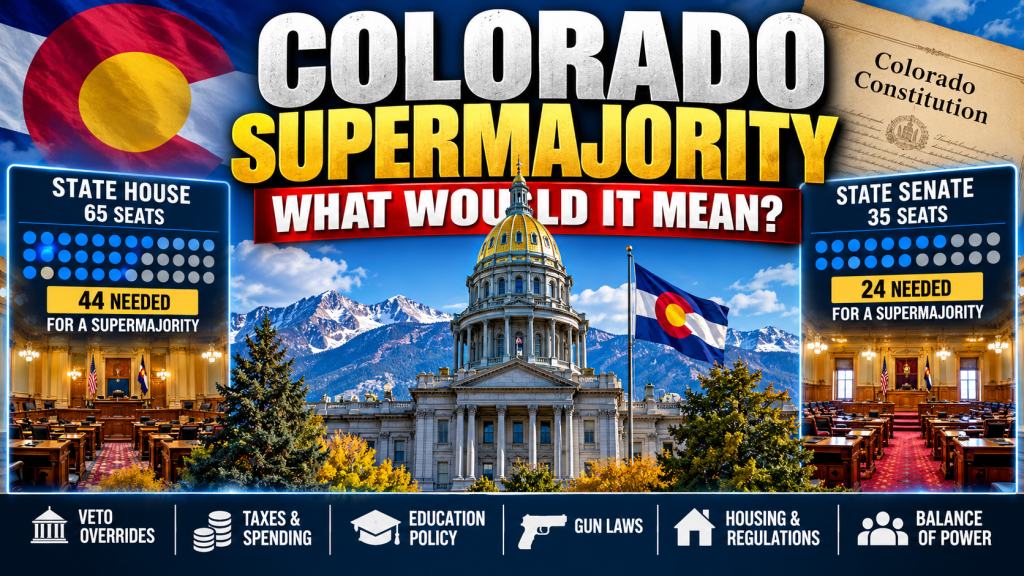
Colorado’s General Assembly has 100 lawmakers divided between two chambers:
- Colorado House of Representatives: 65 members, requiring 44 seats for a supermajority.
- Colorado Senate: 35 members, requiring 24 seats for a supermajority.
Heading into the November 3, 2026, election, Democrats hold 43 seats in the House and 23 in the Senate.
That means Democrats are just one seat short of the two-thirds threshold in each chamber.
However, having a supermajority in one chamber is not the same as controlling both. Certain legislative powers require a two-thirds vote in both chambers.
Why Does a Supermajority Matter?
Under ordinary circumstances, most bills can pass the Colorado Legislature with a simple majority.
That means 33 votes in the House and 18 in the Senate are generally sufficient for final passage.
A supermajority provides additional constitutional powers.
1. Overriding the Governor’s Veto
Colorado’s governor can reject legislation by issuing a veto.
Normally, lawmakers who disagree with the governor must gather enough support to override that decision.
Colorado requires a two-thirds vote in both legislative chambers to override a veto while the Legislature is in session.
If Democrats controlled at least 44 House seats and 24 Senate seats, they could potentially override a governor’s veto without Republican votes.
However, that would require enough Democratic lawmakers to agree on the override. Party membership does not guarantee unanimous voting.
This could become particularly significant when Colorado elects its next governor.
2. Placing Constitutional Amendments Before Voters
Colorado lawmakers can propose changes to the state constitution.
To refer a constitutional amendment to voters, the Legislature generally needs approval from two-thirds of each chamber.
A Democratic supermajority in both chambers could meet that requirement without Republican support.
However, lawmakers cannot simply rewrite the constitution themselves.
Voters would still have the final say.
Most proposed constitutional amendments require at least 55% voter approval, with exceptions for certain repeal-only measures.
What Could Change for Colorado Residents?
A supermajority would not automatically create new laws. But it could change the legislative process and the ability of the majority party to advance proposals.
Taxes and Government Spending
Colorado’s Taxpayer’s Bill of Rights, commonly called TABOR, requires voter approval for tax increases covered by its provisions.
Even with a supermajority, lawmakers could not simply eliminate that constitutional requirement.
However, the Legislature could pursue changes to fees, spending priorities and budget allocations within existing legal limits.
A supermajority could also make it easier to refer proposed constitutional changes involving taxation or government finance to voters.
Education and Parental Rights
Education policy could remain a significant area of debate.
Lawmakers may consider legislation affecting school funding, curriculum requirements, student privacy, parental notification, charter schools and school-district accountability.
A supermajority could strengthen the majority party’s ability to advance its proposals, but ordinary education legislation already generally requires only a simple majority.
School districts would still have responsibilities under state and federal law, and legislation could face judicial review.
Gun Laws
Colorado lawmakers have debated firearm restrictions, background checks, ownership requirements and other public-safety measures.
With a supermajority, the majority party could potentially override a governor’s veto of firearm legislation if enough of its members agreed.
However, state laws would remain subject to constitutional protections and court challenges.
Housing, Energy and Business Regulations
Housing affordability, environmental regulations, energy production, transportation funding and business requirements are also likely to remain important legislative issues.
A supermajority could affect negotiations over these policies, particularly when legislation faces opposition from the governor or requires a constitutionally specified voting threshold.
It would not remove federal legal requirements or the authority of courts to review challenged laws.
What Would Happen to Republicans in the Legislature?
Republican lawmakers would continue representing their districts, introducing legislation, debating proposals, serving on committees and voting.
A supermajority does not eliminate the minority party.
However, if the majority party voted together, Republican support would not be necessary for certain actions that require two-thirds approval.
Critics of legislative supermajorities argue that this can reduce incentives for bipartisan negotiation and weaken the minority party’s influence.
Supporters argue that a supermajority can help an elected majority carry out its policy commitments and reduce legislative gridlock.
Both arguments reflect broader debates about representative government and checks and balances.
Would Democrats Have Unlimited Power?
No.
Even a supermajority must operate within the Colorado Constitution, the U.S. Constitution and applicable federal law.
Several important checks would remain:
- Colorado voters would still decide statewide elections and ballot measures.
- Courts could review laws challenged as unconstitutional.
- TABOR would continue to apply unless changed through a legally valid process.
- Lawmakers would still face regular elections.
- Constitutional procedures and legislative voting requirements would remain in effect.
Additionally, members of the same political party do not always agree on legislation.
A two-thirds majority creates the ability to act without minority-party votes on certain matters. It does not guarantee that every member of the majority will support every proposal.
Has Colorado Had a Supermajority Before?
Yes, but not simultaneously in both legislative chambers under Democratic control.
Democrats held a supermajority in the Colorado House beginning in 2023, but Republicans gained seats in the 2024 election, ending that two-thirds majority.
According to Ballotpedia, neither political party has held a supermajority in the Colorado Senate during the period from 1992 through 2026.
A Democratic supermajority in both chambers following the 2026 election would therefore represent a significant development in Colorado’s legislative history.
What Happens Next?
Colorado’s general election is scheduled for November 3, 2026.
Voters will determine the makeup of the next General Assembly, which is scheduled to convene January 11, 2027.
Whether Democrats gain additional seats, Republicans retain their current positions or the balance shifts in another direction will be determined by election results.
For Colorado residents, the central issue is not simply which political party holds the most seats.
It is how legislative authority is exercised, which policies lawmakers pursue and how constitutional safeguards continue to function.
The Bottom Line
A Democratic supermajority in Colorado would give one party enough legislative votes to exercise certain powers that currently require cooperation across party lines, including overriding gubernatorial vetoes and referring constitutional amendments to voters.
It would not eliminate elections, judicial oversight, constitutional restrictions or voter approval requirements.
For Colorado voters, understanding those distinctions is an important part of evaluating what is at stake in November.
Patriots First Media will continue covering Colorado’s 2026 elections and explaining how decisions at the state Capitol could affect residents across the state.
Article discussion