
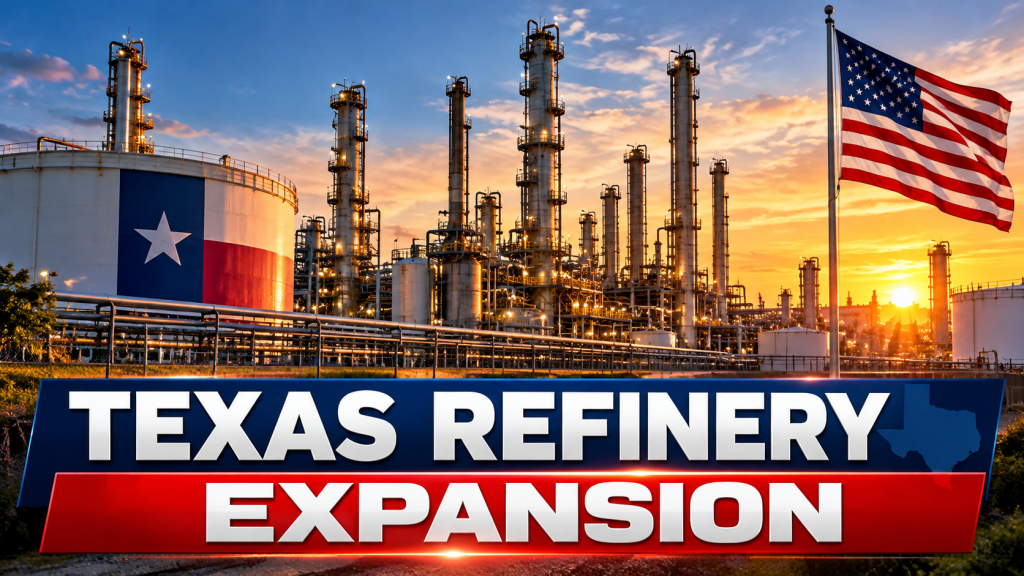
Trump Administration Invokes Defense Production Act to Expand Texas Oil Refinery Amid High Fuel Prices
Vice President JD Vance announces plans to increase production of commercial and military-grade fuel at a Texas refinery as the White House seeks to address rising transportation and energy costs.
TYLER, Texas — October 13, 2026 — The Trump administration announced Tuesday that it will use the Defense Production Act to expand production capacity at a Texas oil refinery, marking a significant federal effort to increase domestic fuel supplies and address concerns about rising energy prices.
Vice President JD Vance announced the initiative during an appearance in Tyler, Texas, where Delek US Holdings operates a refinery capable of processing approximately 74,000 barrels of crude oil per day.
The administration says the expansion is intended to increase production of both commercial transportation fuels and military-grade petroleum products.
The announcement comes as higher fuel costs continue to affect American households, businesses and transportation industries.
What Is the White House Planning?
According to Vance, the federal government will work with Delek US Holdings to expand the refinery’s processing capacity through authorities provided by the Defense Production Act.
The refinery currently processes approximately 74,000 barrels of crude oil daily, equivalent to roughly 3.1 million gallons of crude oil.
However, the administration has not disclosed how much additional processing capacity will be built, how much the expansion will cost or when construction could be completed.
Those details will be important in determining the project’s eventual effect on fuel supplies.
The expansion is intended to increase production of fuels used in commercial transportation and military operations.
What Is the Defense Production Act?
The Defense Production Act is a federal law enacted in 1950 during the Korean War.
It gives the president special authorities to support industries and resources considered essential to national defense.
Depending on the circumstances and statutory requirements, the law can allow the federal government to prioritize certain contracts, support domestic manufacturing and provide financial assistance for critical industrial production.
Although the law is frequently associated with wartime production, it has also been used to address national emergencies and supply-chain challenges.
In April 2026, President Donald Trump issued a presidential determination identifying domestic petroleum production, refining and transportation infrastructure as essential to national defense.
That determination authorized the Department of Energy to pursue measures supporting additional domestic petroleum capacity.
The newly announced Texas refinery project is part of that broader federal energy initiative.
Could the Expansion Lower Gasoline and Diesel Prices?
The administration says increasing refinery capacity could help improve fuel availability and reduce transportation costs.
Additional refining capacity could eventually increase supplies of gasoline, diesel, jet fuel and other petroleum products.
However, expanding an operating refinery is a complex industrial project.
Construction, equipment installation, permitting and testing can take months or even years, depending on the size of the expansion.
As a result, the announcement does not guarantee an immediate reduction in gasoline or diesel prices.
Fuel prices are influenced by numerous factors, including:
- Global crude oil prices and production.
- Refinery operating capacity and maintenance.
- Seasonal demand for gasoline and diesel.
- Transportation and distribution costs.
- International conflicts and supply disruptions.
- Federal and state fuel taxes.
The ultimate impact of the Texas expansion will depend on how much additional fuel the refinery can produce and when that capacity becomes available.
Why Texas Is Important to America’s Energy Industry
Texas plays a major role in American petroleum production, refining and transportation.
The state is home to extensive oil and natural gas infrastructure, pipelines, storage facilities and refineries.
The Delek refinery in Tyler processes crude oil into petroleum products distributed through regional fuel markets.
Expanding an existing facility could potentially increase production without requiring construction of an entirely new refinery.
However, the project’s cost, technical requirements and regulatory approvals remain important considerations.
Military Fuel Production Is Also Part of the Plan
The administration says the refinery expansion will support production of fuel suitable for military operations in addition to commercial transportation.
Reliable petroleum supplies are important for military aircraft, ground vehicles, ships and logistical operations.
Federal officials have identified domestic energy infrastructure as a national-security concern, arguing that disruptions to petroleum supplies could affect military readiness.
The Defense Production Act provides a legal framework for supporting certain industrial capabilities considered necessary for national defense.
What Does This Mean for American Families?
Fuel prices affect much more than the cost of filling a vehicle’s gas tank.
Higher diesel prices can increase expenses for trucking companies transporting groceries, building materials and consumer goods.
Airlines also face substantial fuel costs, which can influence operating expenses and ticket prices.
Farmers, construction companies and manufacturers depend on petroleum products to operate equipment and transport materials.
For families, changes in fuel prices can affect commuting expenses, travel budgets and the cost of everyday goods.
An increase in domestic refining capacity could help strengthen fuel supplies over time, but whether consumers experience lower prices will depend on broader energy market conditions.
Questions That Still Need Answers
Several important details about the announced refinery expansion have not yet been made public.
These include the total federal financial commitment, the amount of additional processing capacity planned, the construction schedule and the expected completion date.
It is also unclear what specific financial or contractual mechanisms under the Defense Production Act will be used to support the project.
The White House and Delek had not provided those details in response to Reuters’ inquiries at the time of its October 13 report.
Further announcements will be necessary to establish the project’s size, cost and timeline.
The Bottom Line
The Trump administration’s decision to use the Defense Production Act to support expansion of the Delek refinery in Tyler, Texas, represents a significant federal initiative involving domestic energy production and national defense.
The administration says the project will increase commercial and military fuel supplies while helping
Article discussion