
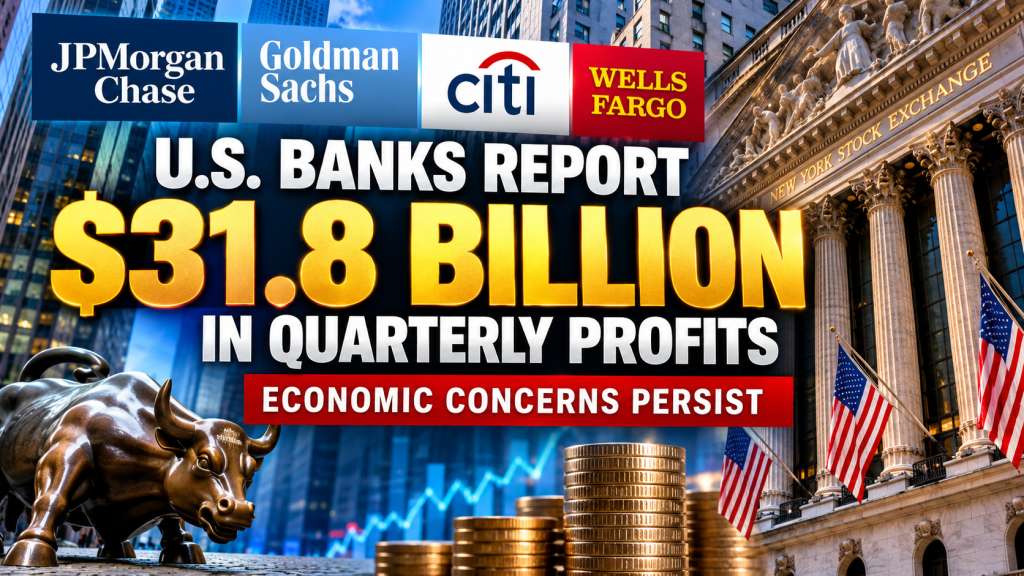
Major U.S. Banks Report Nearly $32 Billion in Quarterly Profits as Economic Concerns Persist
Wall Street’s biggest banks posted strong third-quarter earnings, but executives warn that inflation, elevated interest rates and global uncertainty could create challenges for the American economy.
NEW YORK — October 13, 2026 — Four of America’s largest financial institutions reported combined third-quarter profits of approximately $31.8 billion Tuesday, highlighting the continued strength of the U.S. banking industry even as consumers and businesses face economic uncertainty.
JPMorgan Chase, Goldman Sachs, Citigroup and Wells Fargo all reported higher profits compared with the same period last year. Strong consumer spending, lending activity, investment banking and financial market trading helped support the results.
However, bank executives cautioned that persistent inflation, higher borrowing costs and geopolitical tensions could create additional economic challenges.
Four Major Banks Report Billions in Earnings
The banks reported the following net income for the three months ending September 30, 2026:
| Financial institution | Third-quarter net income |
|---|---|
| JPMorgan Chase | $15.3 billion |
| Goldman Sachs | $5.29 billion |
| Citigroup | Approximately $5.25 billion |
| Wells Fargo | $5.95 billion |
| Combined total | Approximately $31.8 billion |
The earnings provide an important snapshot of the American financial system and the spending and borrowing habits of millions of consumers and businesses.
JPMorgan Chase Reports $15.3 Billion Profit
JPMorgan Chase, the nation’s largest bank by assets, reported third-quarter net income of $15.3 billion, an increase of approximately 6% compared with the previous year.
The bank earned $5.57 per share, below analysts’ expectations of approximately $5.93 per share.
Revenue increased approximately 8% to $50.2 billion.
Despite the earnings increase, the results demonstrated that even highly profitable financial institutions face challenges from changing market conditions.
JPMorgan CEO Jamie Dimon identified inflation, interest rates, government deficits and geopolitical uncertainty among the risks facing the broader economy.
Goldman Sachs Benefits From Financial Market Activity
Goldman Sachs reported net earnings of $5.29 billion and revenue of $18.68 billion for the quarter.
The investment banking giant earned $17.01 per share, exceeding market expectations.
Strong activity in equities trading and demand for financial advisory services contributed to the bank’s performance.
The results demonstrate how major investment banks can generate substantial revenue from financial markets even when economic uncertainty remains elevated.
Citigroup Reports Significant Profit Growth
Citigroup reported approximately $5.25 billion in quarterly profits, an increase of roughly 40% from the same period last year.
The company benefited from improvements across several business divisions, including wealth management, financial services, markets and investment banking.
Citigroup’s results suggest that demand for banking and financial services remains substantial despite concerns about borrowing costs and inflation.
Wells Fargo Reports Higher Earnings
Wells Fargo reported approximately $5.95 billion in net income, compared with $5.59 billion during the third quarter of 2025.
The bank benefited from loan growth and higher interest income.
However, its quarterly revenue of approximately $21.87 billion came in below analysts’ expectations.
The results reflect both the opportunities and challenges created by elevated interest rates.
What Do These Bank Profits Mean for Everyday Americans?
Although billions of dollars in bank profits may seem far removed from everyday household finances, the performance of major financial institutions can provide important clues about the broader economy.
Consumer spending: Continued spending activity can indicate that many households are still making purchases despite higher prices.
Credit cards and personal loans: Interest rates remain an important concern for Americans carrying balances or considering new borrowing.
Mortgages and home purchases: Elevated borrowing costs can make purchasing or refinancing a home more expensive.
Small businesses: Lending conditions influence whether companies can obtain financing to expand, purchase equipment or hire additional workers.
Retirement accounts: Banking stocks are included in many investment funds, meaning the industry’s financial performance can affect retirement and investment portfolios.
Strong bank profits do not necessarily mean that every American household is experiencing financial stability. Banking earnings reflect numerous business activities, including corporate lending, trading and investment services.
Inflation and Interest Rates Remain Major Concerns
Bank executives continue to monitor inflation and interest rates closely.
Higher rates can allow banks to earn more interest on certain loans, but they can also increase funding costs, discourage borrowing and place additional pressure on consumers.
Persistent inflation can reduce household purchasing power, while uncertainty about future interest rates can complicate business investment decisions.
Geopolitical tensions and government borrowing costs are additional concerns for financial markets.
Despite these challenges, the latest earnings reports indicate that major American banks remained profitable through the third quarter.
What Happens Next?
Investors and economists will examine additional bank earnings reports, inflation data and Federal Reserve policy developments for signs of where the economy may be headed.
Bank of America and Morgan Stanley are scheduled to release their third-quarter results Wednesday, October 14.
The broader earnings season will help determine whether the strength reported by Wall Street’s largest institutions extends to other sectors of the economy.
The Bottom Line
Four major U.S. banks earned nearly $32 billion in just three months, demonstrating substantial profitability across the financial sector.
However, the strong results come with warnings about inflation, borrowing costs and economic uncertainty.
For American consumers, the central question is whether continued strength in the banking industry will be accompanied by improving household finances, manageable borrowing costs and sustainable economic growth.
Patriots First Media will continue following the latest economic developments and what they mean for American families and businesses.
Patriots First Media | National Business & Economy News
Sources: JPMorgan Chase third-quarter earnings release; Goldman Sachs third-quarter earnings release; Associated Press, October 13, 2026; Reuters financial reporting, October 13, 2026.
Article discussion