
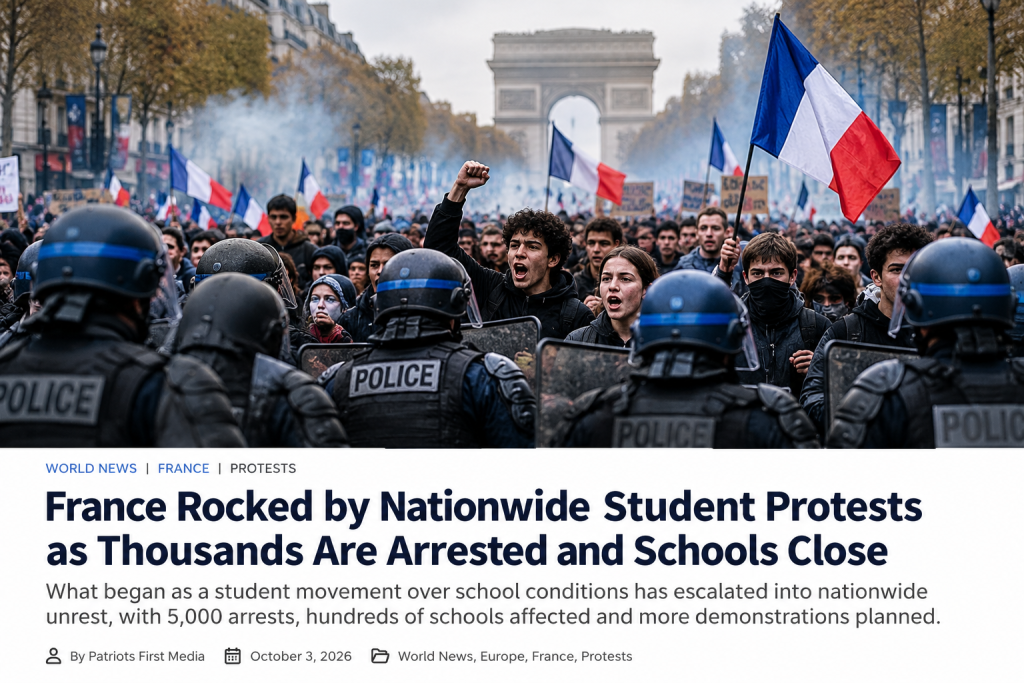
France Rocked by Nationwide Student Protests as Thousands Are Arrested and Schools Close
PARIS, France — October 3, 2026 — What began as student protests over deteriorating schools, overcrowded classrooms and teacher shortages has grown into a nationwide crisis in France, with thousands arrested, hundreds of schools affected and increasingly violent clashes between demonstrators and police.
The unrest began in the Paris suburbs and has rapidly spread to cities across the country. Students initially took to the streets demanding more teachers, improved school buildings, smaller classes and additional education funding.
By Saturday, Paris Police Chief Patrice Faure described the movement as being “out of control” and urged students to return to peaceful demonstrations.
About 5,000 Arrested
According to Reuters, approximately 5,000 people — many of them teenagers — have been arrested across France since Monday.
French police officials said Saturday that more than 600 police officers have been injured during the unrest. Dozens of demonstrators have also been reported injured.
Violence has included fires, vandalism and confrontations with riot police. Teachers and members of the public have also reportedly been attacked.
Property damage is already estimated in the tens of millions of euros.
Authorities have deployed riot police in several cities, where officers have used tear gas during confrontations with demonstrators.
Hundreds of Schools Affected
More than 400 high schools remained closed Friday following days of protests and blockades.
At some schools, students have blocked entrances. Other schools have been closed by authorities because of safety concerns.
The demonstrations have spread well beyond Paris.
Clashes have been reported in cities including Marseille, Toulouse, Strasbourg and Rennes, demonstrating how quickly what began as a local education protest has developed into a national movement.
Why Are Students Protesting?
Students say their frustrations have been building for years.
Among their complaints are:
- overcrowded classrooms;
- shortages of teachers and substitute teachers;
- deteriorating or unsafe school buildings;
- concerns about education funding;
- long school days and academic pressure; and
- frustration with France’s university admissions system.
Students in poorer communities surrounding Paris argue that their schools have been particularly affected by shortages and inadequate facilities.
At Lycée Le Corbusier in Aubervilliers, north of Paris, students told Reuters that schools in disadvantaged neighborhoods routinely face some of the country’s worst conditions.
The demonstrations have also overlapped with broader public-sector protests over government spending and France’s proposed 2027 budget.
Government Calls Emergency Meetings
The growing unrest has forced the French government into crisis meetings.
Prime Minister Sébastien Lecornu called senior government officials together as demonstrations became increasingly violent.
Education Minister Édouard Geffray acknowledged that the original concerns raised by students were legitimate but said the movement had changed as violence increased.
French officials have alleged that radical political activists and organized troublemakers have become involved in some demonstrations.
Those claims are disputed politically, and the original student grievances over education conditions remain separate from allegations about people responsible for later violence.
President Emmanuel Macron’s government has said students have the right to demonstrate peacefully while warning that attacks, arson and vandalism will be prosecuted.
Police Chief Warns Movement Has Escalated
Paris Police Chief Faure issued an unusually direct warning Saturday.
He said the people who originally launched the student movement no longer appear to control everything happening in the streets.
He urged parents to discourage their children from participating in violence and called on students to abandon violent confrontations and school blockades in favor of peaceful demonstrations.
Authorities are particularly concerned about the possibility that organized extremist groups could exploit larger student gatherings.
More Demonstrations Are Coming
The situation may not be over.
Student organizations have called for another national day of demonstrations Tuesday, October 6.
French security officials are preparing for the possibility of additional unrest, particularly in central Paris.
The demonstrations are also unfolding at a politically sensitive moment. France is approaching its 2027 presidential election, in which Macron cannot seek another consecutive term, and political parties across the spectrum are already debating how the government has handled the protests.
What Started as a School Protest Has Become a National Crisis
The scale of the unrest has transformed what began as complaints about teachers, classrooms and school conditions into one of France’s most significant youth protest movements in recent years.
For now, the students’ original demands remain centered on education.
But with thousands arrested, hundreds of police officers injured, schools closed across the country and another nationwide demonstration scheduled, French authorities are trying to prevent the movement from escalating further.
Patriots First Media will continue monitoring developments in France as authorities prepare for the next nationwide demonstrations.
Sources: Reuters, Associated Press, Le Monde and statements from French government and police officials. Figures remain subject to change as authorities update arrest, injury and school-closure totals.
Article discussion