
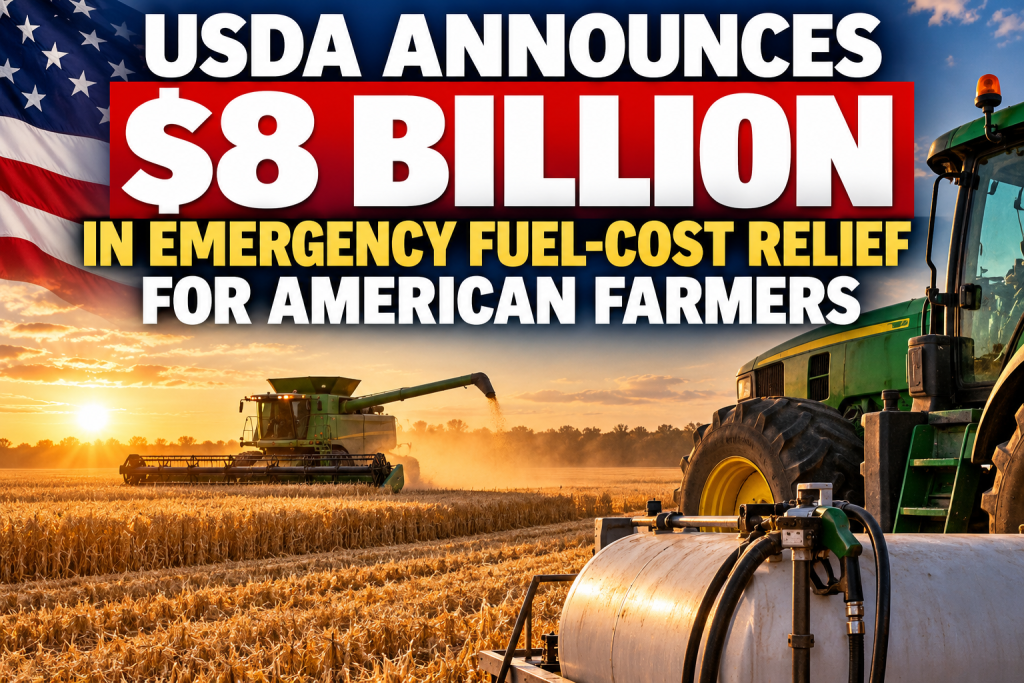
USDA Announces $8 Billion in Emergency Fuel-Cost Relief for American Farmers
New Harvest Fuel Relief program aims to help agricultural producers struggling with rising diesel prices and operating expenses during the 2026 harvest season.
WASHINGTON, D.C. — October 19, 2026 — The Trump administration announced Monday that the U.S. Department of Agriculture (USDA) will provide $8 billion in financial assistance to American farmers facing increased fuel costs and other financial pressures during the 2026 harvest season.
President Donald Trump announced the new Harvest Fuel Relief (HFR) program during an appearance in Park City, Kansas. Agriculture Secretary Brooke Rollins confirmed the initiative, which will provide one-time payments to eligible agricultural producers nationwide.
The announcement comes as farmers across the country struggle with rising diesel prices, higher production expenses and market uncertainty.
$8 Billion in Relief for American Agriculture
According to the USDA, the Harvest Fuel Relief program is designed to offset a portion of farmers’ financial losses during the 2026 crop year.
The assistance will be administered through the USDA’s Farm Service Agency (FSA), using funding authorized under the Commodity Credit Corporation Charter Act.
Unlike a reimbursement program based solely on fuel receipts, the payments will be calculated using a formula that considers agricultural production and estimated financial losses.
The USDA says the formula will incorporate:
- Reported planted acreage.
- Estimated agricultural production costs.
- Crop yields.
- Commodity market prices.
- National estimates of financial losses during the 2026 growing season.
The department expects to announce commodity-specific payment rates for major agricultural crops in November. Details for other eligible commodities will be released later.
Rising Diesel Prices Put Pressure on Farmers
Fuel is one of the most important operating expenses in American agriculture.
Diesel powers tractors, combines, irrigation equipment and the trucks used to transport crops and livestock.
When diesel prices increase, farmers face higher expenses for planting, harvesting and moving agricultural products to market.
Those costs come on top of expenses for fertilizer, equipment, maintenance, labor and agricultural supplies.
For many producers, these increases can significantly reduce profits, particularly when commodity prices fail to keep pace.
The new federal assistance is intended to provide temporary financial relief rather than permanently reduce fuel prices.
How Farmers Can Apply for Assistance
The USDA says eligible farmers should begin preparing for the application
Article discussion