
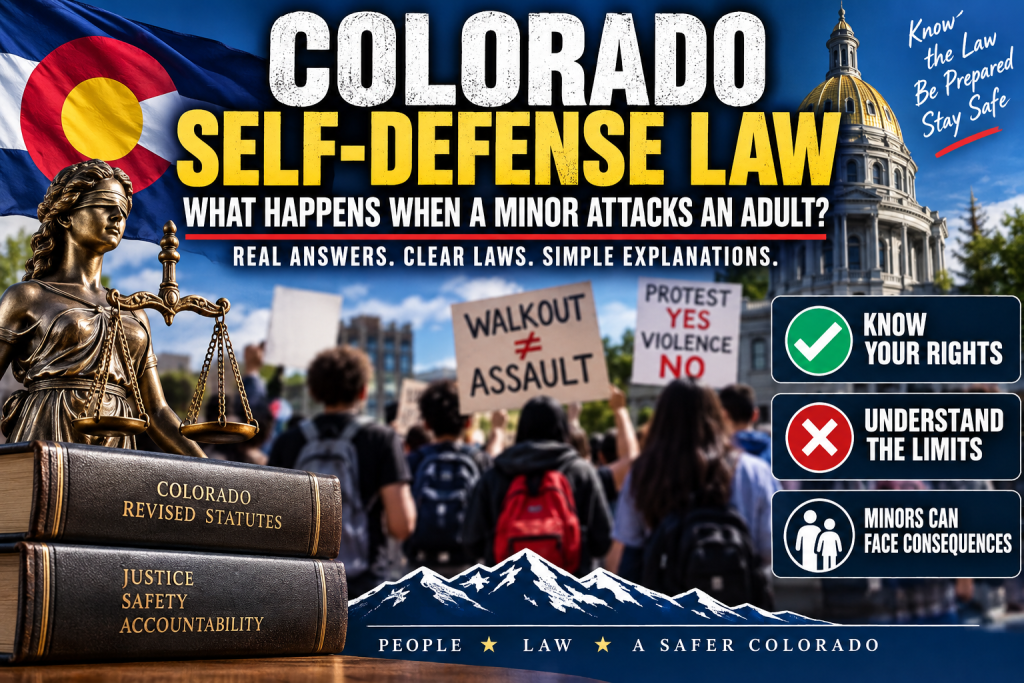
Colorado Self-Defense Law: What Happens When a Minor Attacks an Adult?
What the Denver student walkout shows about assault, self-defense, and minors
After the September 4 student walkout in Denver, videos and news reports showed confrontations between students and counterprotesters at La Alma-Lincoln Park.
According to news reports, Denver police said there were at least five assaults or altercations, three people were transported to hospitals, and investigators identified several suspects. CPR News reported that some students shoved people and hit or threw water bottles at them. The Denver Gazette also reported that a woman had her hair pulled and was punched in the face. Police said the investigations were continuing.
That raises an important question:
What can an adult legally do if the person attacking them is a minor?
The simplest answer is:
You do not lose your right to defend yourself just because the person attacking you is under 18.
But that does not mean an adult can use whatever amount of force they want.
Colorado law focuses on the threat and the amount of force reasonably necessary to stop it.
THE BASIC COLORADO RULE
Colorado Revised Statutes § 18-1-704 says a person may use physical force to defend themselves or another person when they reasonably believe someone is using, or is about to use, unlawful physical force against them.
The law permits the defender to use the degree of force that the defender reasonably believes is necessary for that purpose.
Put into everyday English:
Someone attacks you → You may defend yourself.
Someone is about to attack you → You don’t necessarily have to wait for the first punch to land.
The attacker is 16 instead of 26 → You still have a right to defend yourself.
But you may use only the force you reasonably believe is necessary to defend yourself.
That last sentence is extremely important.
BEING A MINOR IS NOT A LICENSE TO ASSAULT SOMEONE
There seems to be a common misconception that an adult simply has to stand there and take an assault because the attacker is a teenager.
That is not what Colorado’s self-defense statute says.
Section 18-1-704 speaks about defending yourself from unlawful physical force by another person. It does not create a general rule saying that an adult loses self-defense rights when the attacker happens to be a minor.
A teenager’s age may certainly matter when police, prosecutors and juvenile courts deal with what happened.
But age does not magically turn otherwise unlawful physical force into lawful physical force.
HERE IS THE EASY WAY TO UNDERSTAND IT
Imagine someone starts punching you.
You put your arms up.
You push the attacker away.
The attacker comes at you again.
You use enough physical force to stop the attack.
That can potentially be lawful self-defense.
Now change one fact:
The attacker is 16.
Your basic right to defend yourself does not disappear.
But everything still comes down to whether the amount of force you used was reasonably necessary.
YOU CAN DEFEND YOURSELF — YOU CANNOT TAKE REVENGE
This is probably the most important distinction in the entire law.
Self-defense is for stopping danger.
Self-defense is not permission to punish somebody afterward.
For example:
A teenager punches an adult.
The adult pushes the teenager away and stops the attack.
The teenager backs away and the danger ends.
The adult generally cannot then chase the teenager down and start beating them because the adult is angry about being punched.
Why?
Because once the threat has ended, the justification for defensive force can end too.
Remember this simple rule:
STOP THE ATTACK — DON’T TURN IT INTO REVENGE.
WHAT IF SEVERAL MINORS ATTACK ONE ADULT?
This can change the situation significantly.
Colorado’s rule is based on what the person reasonably believes is necessary to protect themselves.
That means circumstances matter.
There is an obvious difference between:
One smaller teenager shoving an adult once
and
A group surrounding an adult, knocking the adult down, kicking the adult and continuing the attack.
The law does not simply count birthdays.
The relevant questions include what was happening, how serious the threat appeared to be, whether the attack was continuing, and what level of defensive force reasonably appeared necessary.
WHAT ABOUT WATER BOTTLES, DRINKS, SHOVING AND HAIR-PULLING?
Do not assume something has to be a closed-fist punch before self-defense becomes possible.
During Friday’s Denver demonstration, news reports described students throwing water bottles or drinks, shoving people, and other physical confrontations. CPR reported that teachers, organizers and Denver Public Schools security attempted to hold students back and redirect them.
Whether a particular act legally constitutes an assault and whether a particular defensive response is justified depends on the facts.
The safest rule is:
Words alone are different from someone actually using or imminently threatening unlawful physical force.
Someone insulting you does not automatically give you permission to hit them.
Someone disagreeing with your politics does not give you permission to hit them.
Someone filming you does not automatically give you permission to hit them.
But when someone begins using unlawful physical force against you, Colorado’s self-defense statute can apply.
WHAT IF SOMEONE GRABS YOUR SIGN OR PROPERTY?
Be careful here.
A dispute over property does not automatically justify punching or seriously injuring someone.
Protecting yourself from an attack and protecting property are legally different questions.
If someone grabs a sign and runs away, that does not automatically mean you can chase them down and beat them.
If someone grabs the sign while simultaneously attacking you, however, the self-defense analysis concerns the physical threat to you — not simply ownership of the sign.
CAN AN ADULT PUNCH A MINOR IN SELF-DEFENSE?
Potentially, yes — but only when the circumstances legally justify that degree of force.
The question isn’t simply:
“Did an adult hit a kid?”
The better legal questions are:
Who was using or imminently threatening unlawful physical force?
What did the adult reasonably believe was happening?
How much defensive force reasonably appeared necessary?
Did the adult stop when the threat stopped?
That is why video evidence can become extremely important.
A few seconds before and after a punch can completely change how an incident looks.
WHAT ABOUT DEADLY FORCE?
This is where the law becomes much stricter.
Colorado does not allow deadly physical force simply because someone punched or shoved you.
Under § 18-1-704, deadly physical force is limited to specified serious circumstances. Among them, the defender must reasonably believe a lesser degree of force is inadequate and reasonably believe they or another person face imminent death or great bodily injury, or certain specified serious crimes are occurring or about to occur.
So:
A shove does not automatically justify deadly force.
A thrown drink does not automatically justify deadly force.
An insult certainly does not justify deadly force.
The seriousness of the threat matters enormously.
YOU ALSO CANNOT START THE FIGHT AND THEN CLAIM SELF-DEFENSE
Colorado law places important restrictions on someone who provokes violence or is the initial aggressor.
Generally, a person cannot intentionally provoke someone into using unlawful physical force and then simply claim self-defense.
An initial aggressor also faces restrictions, although Colorado law provides circumstances in which self-defense can become available again after the person withdraws and effectively communicates that withdrawal but the other person continues or threatens unlawful force.
In child-simple language:
DON’T START A FIGHT AND THEN CLAIM YOU WERE JUST DEFENDING YOURSELF.
WHAT IF YOU ARE SURROUNDED?
Being surrounded does not automatically give someone permission to start hitting people.
But the entire situation matters.
Imagine ten people surrounding one person, blocking movement, threatening them and beginning to physically attack.
That situation is very different from ten people standing nearby yelling.
Self-defense is based on an actual or reasonably perceived imminent use of unlawful physical force — not simply fear caused by unpopular opinions, insults or a hostile crowd.
WHAT HAPPENED IN DENVER?
According to CPR News, the September 4 demonstration at La Alma-Lincoln Park was mostly peaceful but became tense when counterprotesters and students confronted each other.
CPR reported that some students yelled at and shoved counter protesters and hit them with water bottles. Denver Police reported at least five assaults or altercations and three people transported to hospitals.
Colorado Newsline similarly reported that students screamed at counterprotesters, tried to run them out of the park and threw water bottles or drinks. It reported that organizers repeatedly told students not to engage and to remain peaceful. Police described five assaults/altercations and said investigations were ongoing.
The Denver Gazette reported another disturbing allegation: an unidentified woman had her hair pulled and was punched in the face.
Those reports matter, but they do not establish every participant’s criminal guilt or prove that every reported incident legally qualifies as assault.
Police were still investigating.
The complete video, witness statements and circumstances surrounding each confrontation matter.
MINORS CAN FACE CONSEQUENCES FOR ASSAULT
Being under 18 does not make physical violence legal.
Colorado has a juvenile justice system for handling alleged offenses committed by juveniles, and the consequences and procedures can differ substantially from those involving adults.
The important point for purposes of self-defense is simple:
“I’m a minor” does not mean “I’m legally allowed to attack an adult.”
And:
“He’s a minor” does not mean “the adult isn’t allowed to protect himself.”
THE 10-SECOND VERSION
If you remember nothing else, remember this:
1. A minor cannot legally assault someone just because they are a minor.
2. An adult does not automatically lose the right to self-defense because the attacker is under 18.
3. You may defend yourself from unlawful physical force or its imminent use.
4. The amount of force you use must be reasonably necessary under the circumstances.
5. You cannot hit someone merely because they insulted you or disagree with you.
6. You cannot use self-defense as an excuse for revenge.
7. When the threat stops, your justification for defensive force may stop.
8. Deadly force has a much higher legal threshold.
9. Starting or deliberately provoking a fight can seriously damage a self-defense claim.
10. Call 911, get away when safely possible, preserve video and identify witnesses.
THE SIMPLEST RULE OF ALL
Think about self-defense like a STOP button, not a PUNISH button.
If someone unlawfully attacks you, Colorado law can allow you to use reasonably necessary force to protect yourself.
Once you are safe and the attack is over, your job is not to punish the attacker.
Call police.
Save your video.
Get witnesses.
Photograph injuries.
Get medical treatment when necessary.
Let investigators determine what happens next.
Whether the person attacking you is 15, 25 or 55, their age does not by itself erase your right to defend yourself.
But their age also does not give you permission to use unlimited force.
The key question remains: Was the force reasonably necessary to protect yourself or another person from unlawful physical force?
Important note
This article provides general information about Colorado law and is not individualized legal advice. Every self-defense case depends heavily on its specific facts. Anyone involved in a serious physical confrontation or facing criminal charges should speak with a qualified Colorado criminal-defense attorney.
Sources
Colorado General Assembly — Colorado Revised Statutes, including C.R.S. § 18-1-704.
CPR News — coverage of the September 4, 2026 Colorado student walkout and Denver confrontations.
Colorado Newsline — coverage of the September 4 Denver demonstration and reported assaults/altercations.
The Denver Gazette — coverage of the September 4 demonstration, reported assaults and hospitalizations.
Article discussion