
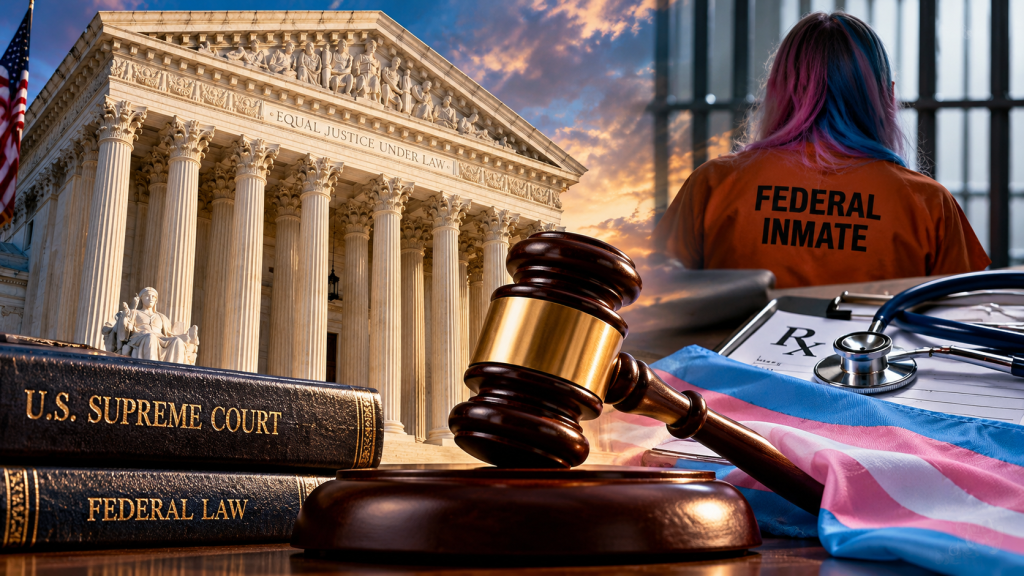
Supreme Court Rejects Trump Administration’s Emergency Request to Enforce Medical Restrictions for Transgender Federal Inmates
WASHINGTON, D.C. — October 22, 2026 | Patriots First Media
The United States Supreme Court rejected an emergency request from the Trump administration on Wednesday, October 21, preventing the federal government from immediately implementing new restrictions on medical treatments and accommodations for transgender inmates in federal prisons.
The decision leaves a lower federal court’s injunction in place while a legal challenge to the administration’s policy continues.
In a brief, unsigned order, the Supreme Court declined to grant the Justice Department’s request to suspend the lower court ruling. Justices Clarence Thomas and Samuel Alito indicated they would have granted the administration’s application.
The Court did not provide an explanation for its decision.
What Restrictions Did the Administration Propose?
The dispute centers on changes to Federal Bureau of Prisons policies following an executive order issued by President Donald Trump in January 2025.
The administration sought to restrict several forms of gender-related medical treatment and accommodations for transgender federal inmates, including:
- Hormone therapy prescribed for gender dysphoria.
- Gender-transition surgical procedures.
- Personal items and accommodations such as wigs, makeup, breast padding and chest binders.
Under the proposed policy, prison officials would instead emphasize psychiatric services, psychotherapy and counseling for inmates diagnosed with gender dysphoria.
The administration argued that the restrictions were justified by medical considerations, prison security concerns and the federal government’s authority to establish correctional policies.
However, the changes faced legal challenges from inmates who argued that ending previously prescribed treatments could cause significant medical and psychological harm.
Federal Judge Previously Blocked the Policy
U.S. District Judge Royce Lamberth previously blocked the Bureau of Prisons from implementing the restrictions.
The judge concluded that the agency had not adequately justified its departure from longstanding medical policies and had likely violated requirements under the Administrative Procedure Act.
That federal law governs how agencies establish and change administrative rules.
The court questioned whether prison officials had sufficiently considered existing medical evidence and the consequences of discontinuing treatment for inmates already receiving care.
The Trump administration challenged the injunction, arguing that federal prison administrators should receive substantial discretion when making decisions involving inmate healthcare and institutional security.
After the administration failed to obtain relief from the lower courts, the Justice Department sought emergency intervention from the Supreme Court.
Supreme Court Declines Emergency Intervention
Wednesday’s decision means the lower court’s restrictions on implementing the new Bureau of Prisons policy will remain in effect while the litigation continues.
The ruling does not require every transgender inmate to receive hormone therapy or surgery. Rather, it prevents enforcement of the challenged categorical restrictions and preserves consideration of treatment under the existing legal framework.
Justices Thomas and Alito publicly indicated their disagreement with denying the administration’s emergency request.
The remaining justices did not provide individual explanations for their positions.
Importantly, the Supreme Court did not issue a final ruling on whether the administration’s policy is lawful.
How Many Federal Inmates Could Be Affected?
According to federal court records cited by the Associated Press, approximately 600 federal inmates were receiving hormone therapy in 2025.
The broader population of transgender inmates in federal custody is estimated to be larger.
The legal dispute could affect inmates currently receiving treatment, as well as those who may seek medical evaluations and treatment in the future.
The case concerns federal correctional facilities operated by the Bureau of Prisons. It does not automatically establish medical treatment requirements for state prisons or county jails.
What Happens Next?
The underlying lawsuit will continue through the federal court system.
The Justice Department may continue defending the administration’s policy and pursuing further legal arguments.
Future proceedings could address whether the Bureau of Prisons followed federal administrative law, adequately considered relevant medical evidence and lawfully exercised its authority when changing inmate healthcare policies.
For now, the Supreme Court’s refusal to intervene means the challenged restrictions cannot be enforced while the lower court’s injunction remains in place.
The decision is temporary in its legal effect and does not settle the broader dispute over transgender medical care in federal prisons.
Sources
- Reuters — Supreme Court Won’t Allow Trump Administration Restrictions on Transgender Inmates, October 21, 2026.
- Associated Press — Supreme Court Rebuffs Trump Administration Restrictions on Medical Care for Transgender Inmates, October 21, 2026.
- CBS News — Supreme Court Rejects Trump Bid to Restrict Some Medical Treatments for Transgender Inmates, October 21, 2026.
- U.S. Supreme Court — Trump v. Kingdom, emergency application No. 26A416, court filings and order.
Patriots First Media | National News | Federal Courts
Article discussion