Is the United States a Democracy?
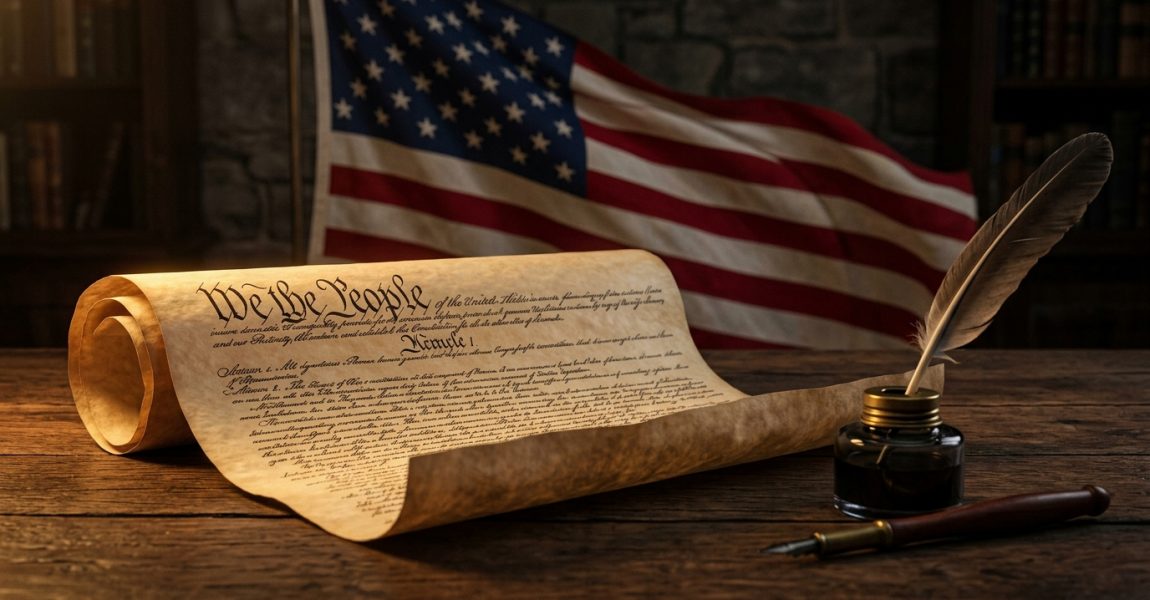
The United States is frequently called a “democracy,” especially in political rhetoric, but this is an incomplete and often misleading description. America is a constitutional republic — specifically, a constitutional federal republic with strong representative and democratic elements. The distinction matters because it goes to the heart of how our government was designed to protect individual liberty rather than allow unchecked majority rule. The word “democracy” does not appear in the U.S. Constitution. Article IV, Section 4 guarantees to every state “a Republican Form of Government.” The Founders deliberately created a system of representative government limited by a written Constitution, separation of powers, checks and balances, federalism, and the Bill of Rights. They were deeply skeptical of pure democracy. James Madison warned in Federalist No. 10 that democracies “have ever been spectacles of turbulence and contention” and “incompatible with personal security or the rights of property.” John Adams noted that “democracy never lasts long. It soon wastes, exhausts, and murders itself.” Alexander Hamilton and others echoed concerns that pure majority rule could descend into mob rule or tyranny of the majority.
dailysignal.com In a pure or direct democracy, the majority could vote away the rights of minorities at any time. Our republic prevents that by requiring elected representatives to deliberate, by insulating certain rights (speech, religion, arms, due process) from simple majorities, and by structures like the Electoral College, Senate (originally chosen by state legislatures), and an independent judiciary. We elect leaders who then govern under the rule of law — not raw popular will on every issue. This is why America has endured as a stable free society far longer than many pure democracies in history. That said, the U.S. incorporates democratic mechanisms: regular elections, universal adult suffrage, and the principle that government derives its just powers from the consent of the governed. It is more accurately described as a representative democracy operating within a constitutional republic, or a “democratic republic.” The key is the Constitution’s supremacy — it is not whatever 51% of voters want on a given day.
Why the Left Emphasizes That America “Is a Democracy “Many on the political left prefer the term “democracy” (or “our democracy”) for several reasons:
- It highlights popular sovereignty and majority rule, which aligns with progressive goals of expanding government power to achieve social and economic “equality.” Framing issues as threats to “democracy” makes restrictions on speech, changes to voting rules, or centralizing authority sound like defenses of the people’s will rather than power grabs.
- It blurs the distinction with pure democracy, making constitutional safeguards (Electoral College, Senate filibuster, state powers, Second Amendment) appear outdated or anti-democratic. Proposals like abolishing the Electoral College or packing the Supreme Court are often justified as making the system “more democratic.”
- Historically, “democracy” became a broader, more positive buzzword in the 20th century, especially post-WWII and during the Civil Rights era. Left-leaning academics, media, and politicians use it to evoke ideals of inclusion and equality, while downplaying the Founders’ warnings about its dangers. Some view the republic’s limits on majority power as barriers to transformative change (e.g., wealth redistribution, expansive regulatory state).
In short, calling America simply “a democracy” shifts focus from limited government and individual rights to majority will and collective outcomes. It makes it easier to argue that any constitutional feature frustrating progressive priorities is “undemocratic” and thus illegitimate.
Why the Left Claims “Our Democracy Is in Danger” For years, particularly since 2016, prominent voices on the left have warned that American democracy faces an existential threat — usually tied to conservatives, Republicans, or specifically Donald Trump and the MAGA movement. Common claims include:
- “Threats to the peaceful transfer of power” — referencing January 6, 2021, and skepticism about election integrity in 2020.
- “Attacks on voting rights” — opposition to measures like voter ID, purging inactive rolls, or limits on mail-in ballots is portrayed as “voter suppression,” even as many such rules existed for decades and are common in other democracies.
- “Authoritarianism and fascism” — rhetoric labeling opponents as threats to norms, institutions, or the rule of law. In recent years (including 2025 analyses), some left-leaning outlets and think tanks have pointed to executive actions, agency reforms, immigration enforcement, or perceived weakening of checks and balances as evidence of democratic “backsliding” or even a slide toward “competitive authoritarianism.”
- Polarization and institutional distrust — broader concerns about declining trust in media, academia, and federal agencies, often blamed on the right rather than on perceived left-wing overreach in those institutions.
These warnings intensified around elections and have been amplified by media, academics, and Democratic leaders. Post-2024/2025 assessments from groups tracking global democracy sometimes scored the U.S. lower due to executive power expansions, congressional gridlock, or partisan perceptions of the judiciary — though critics note these metrics can be subjective and influenced by ideological priors. From a counter-perspective, many see this narrative as exaggerated or hypocritical. The republic’s safeguards (courts, states, elections) have held through intense polarization. Concerns about democracy often seem selective: left-leaning policies like lawfare against political opponents, pressure on social media to censor views, expansive administrative state rulemaking bypassing Congress, or attempts to alter fundamental structures (court packing, statehood for D.C./Puerto Rico to shift Senate balance) receive less scrutiny as “threats.” The Founders designed the system precisely to withstand passionate majorities and demagogues — not to be fragile against one side’s rhetoric or policy disagreements. True dangers to the republic would involve eroding constitutional limits, undermining the rule of law equally applied, or fostering permanent one-party dominance through institutional capture. Both sides have contributed to polarization, but the solution lies in returning to first principles: respecting the Constitution as written, protecting individual rights regardless of which party holds power, and rejecting the idea that “democracy” means the majority (or the loudest voices) gets whatever it wants. America is not a pure democracy — and that’s a feature, not a bug. Our constitutional republic has preserved liberty amid deep divisions for over two centuries. The real threat comes not from honest debate over its nature, but from those who would trade its restraints for unchecked power in the name of “saving democracy”.
What do you think?
Share your thoughts in the comments, and consider what steps we can take to strengthen our republic for future generations.