
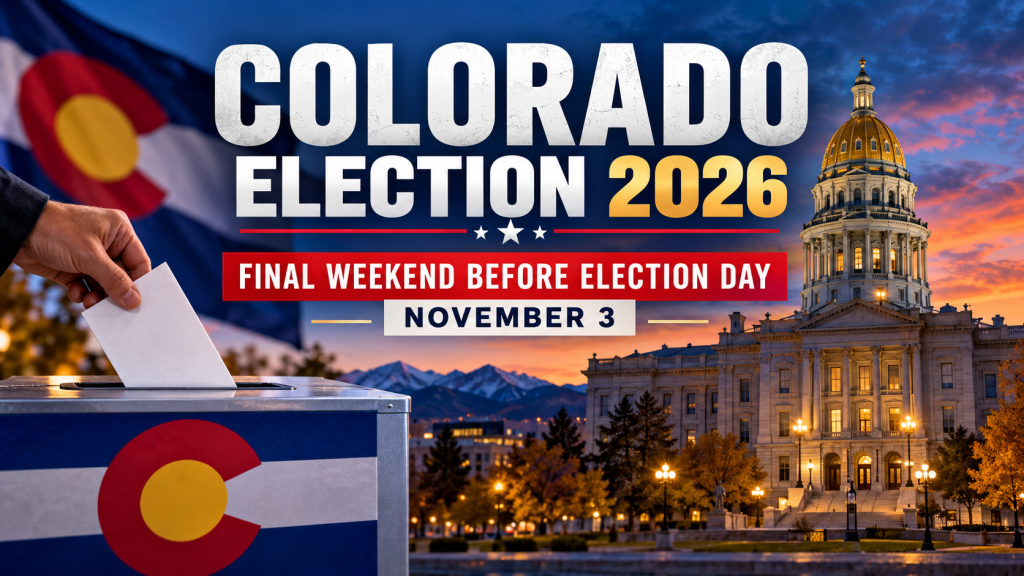
Colorado Enters Final Election Weekend as Ballot Returns Top 1.2 Million and Key Races Draw Attention
Unaffiliated voters lead statewide ballot returns as Colorado’s governor, U.S. Senate and 5th Congressional District contests head toward November 3.
By Patriots First Media | October 30, 2026
COLORADO SPRINGS, Colo. — With Election Day just four days away, Colorado voters are returning ballots in growing numbers as candidates make their final appeals ahead of Tuesday’s general election.
More than 1.22 million ballots had been returned statewide through October 28, according to Colorado Secretary of State data compiled by FundVoter. The numbers show substantial participation by unaffiliated voters and increased early ballot returns compared with the same point in the 2022 midterm election.
Among the races on the ballot are contests for governor, U.S. Senate and Colorado’s 5th Congressional District, which includes Colorado Springs.
Unaffiliated Voters Lead Early Ballot Returns
As of October 28, Colorado election officials reported 1,227,635 returned ballots.
The breakdown by voter registration included:
- Unaffiliated: 519,813 ballots
- Democratic: 390,922 ballots
- Republican: 301,916 ballots
- Minor parties combined: 14,984 ballots
Compared with the same number of days before Election Day in 2022, ballot returns were approximately 22% higher among registered Democrats, 5% higher among registered Republicans and 43% higher among unaffiliated voters.
However, Colorado mailed ballots earlier in the 2026 election cycle, complicating direct comparisons.
These figures represent voter registration, not votes cast for individual candidates. Election officials have not released general election results.
Colorado Governor’s Race: Weiser and Marx Compete for Open Seat
Democratic Attorney General Phil Weiser and Republican Victor Marx are competing to succeed term-limited Democratic Governor Jared Polis.
Weiser secured the Democratic nomination during Colorado’s June primary, while Marx won the Republican nomination.
The race has drawn attention to competing approaches to state government, including economic policy, public safety, education and Colorado’s relationship with the federal government.
With the governorship changing hands regardless of the outcome, voters will select the state’s next chief executive at a time when questions about affordability, public spending and the direction of state policy remain prominent.
U.S. Senate: Hickenlooper Faces Republican Mark Baisley
Democratic U.S. Senator John Hickenlooper is seeking another term against Republican Mark Baisley.
Hickenlooper, a former Colorado governor, won the Democratic primary and is seeking to retain the Senate seat he first won in 2020.
The contest gives Colorado voters a choice between continuing Hickenlooper’s representation in Washington and electing Baisley, a former state legislator.
The outcome will contribute to determining the makeup of the U.S. Senate for the next two years.
Colorado’s 5th Congressional District Draws Local Attention
One of the most closely watched races in southern Colorado is the contest between Republican incumbent Jeff Crank and Democratic challenger Jessica Killin.
Colorado Public Radio reported October 29 that the district is experiencing an unusually competitive campaign, with extensive advertising, political mail and direct voter outreach.
The district has historically been represented by Republicans, making the level of attention surrounding this year’s contest noteworthy.
Both campaigns are working to reach voters in Colorado Springs and surrounding communities during the final days before Election Day.
The race also places local concerns, including economic conditions, federal policy and representation in Congress, before voters.
El Paso County Officials Monitor Turnout
In El Paso County, Clerk and Recorder Steve Schleiker reported that nearly 19% of registered voters had cast ballots as of October 26.
At that point, accepted mail ballots included approximately 40,000 from unaffiliated voters, 30,000 from registered Republicans and 22,000 from registered Democrats.
More than 11,000 additional mail ballots had been received but had not yet been processed, according to local reporting.
Schleiker said he was cautiously optimistic that turnout could reach 70% to 75% of active registered voters, while emphasizing that the figure was an estimate rather than a guaranteed outcome.
For comparison, El Paso County recorded approximately 61% turnout in the 2022 midterm election and 70% in 2018.
Early participation has also varied across the county. Some precincts on the western side of Colorado Springs reported participation above 30%, while precincts encompassing military installations and parts of southeast Colorado Springs recorded lower early turnout.
Final Weekend Before Election Day
Colorado voters have until 7 p.m. Tuesday, November 3, to return their ballots.
Ballots must be received by the deadline; a postmark alone does not qualify.
Voters who have not returned their ballots can use an official ballot drop box or a Voter Service and Polling Center.
As the final weekend approaches, the central unanswered question is how many additional Coloradans will participate before voting closes.
The early ballot data shows strong participation across registration categories, but the results of the governor’s race, Senate contest and congressional elections will not be known until votes are counted.
Patriots First Media will continue following Colorado’s election developments and results as voters head toward November 3.
Sources: Colorado Secretary of State ballot-return data via FundVoter; Colorado Public Radio; The Colorado Springs Gazette; Colorado Politics.
Article discussion