
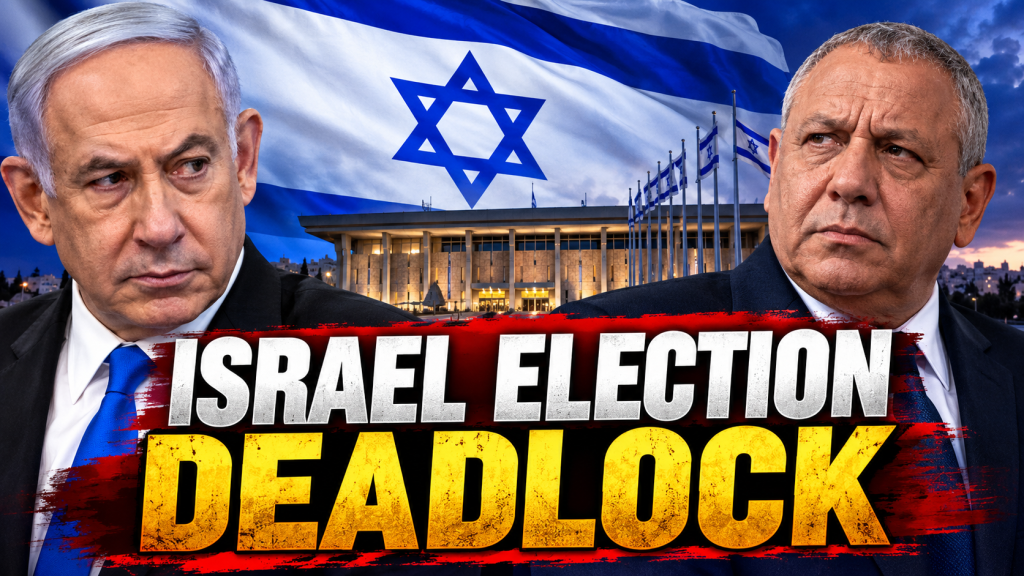
Israel Election Deadlock: Netanyahu Leads but Falls Short of Majority as Trump Weighs In
October 28, 2026 | Patriots First Media | World News
JERUSALEM, ISRAEL — Israeli Prime Minister Benjamin Netanyahu is facing an uncertain political future following Tuesday’s national election, as preliminary results show his right-wing coalition leading the vote but falling short of the parliamentary majority needed to form a government.
The closely watched election has drawn international attention, particularly from the United States, where President Donald Trump publicly endorsed Netanyahu ahead of the vote.
With approximately 85.6% of total ballots counted Wednesday, Netanyahu’s political bloc was projected to secure 53 seats in Israel’s 120-member parliament, known as the Knesset. The opposition bloc led by former Israeli military chief Gadi Eisenkot was projected to win 48 seats, while Arab-led parties were expected to secure 19 seats.
A minimum of 61 seats is required to control parliament.
Although Netanyahu’s bloc holds the lead, neither major political alliance currently has enough seats to govern independently.
Netanyahu Calls for a Right-Wing Government
Speaking to supporters at Likud party headquarters in Jerusalem early Wednesday morning, Netanyahu called for the establishment of a strong right-wing government.
The longtime Israeli leader emphasized his administration’s military accomplishments and argued that Israel needs continued strong leadership amid ongoing security threats throughout the Middle East.
Netanyahu also warned against the possibility of an opposition government relying on Arab-led political parties.
Despite his coalition losing its parliamentary majority in the preliminary results, Netanyahu remains prime minister while the political parties negotiate over the formation of a new government.
Opposition Leader Says Israelis Voted for Change
Netanyahu’s principal challenger, Gadi Eisenkot, offered a different interpretation of the election.
Eisenkot, a former chief of staff of the Israel Defense Forces and leader of the Yashar party, argued that voters had expressed a desire for new political leadership.
His opposition alliance includes parties spanning different political ideologies, united largely by their opposition to Netanyahu’s continued leadership.
However, forming a government could prove difficult.
The opposition would likely need support from Arab-led parties, a politically sensitive arrangement that some potential coalition partners have opposed.
The election also produced a historic showing for Arab-led parties, which were projected to control 19 parliamentary seats.
Those seats could become central to negotiations over Israel’s next government.
President Trump Weighs In on Netanyahu’s Election
The Israeli election has also attracted attention in Washington.
President Donald Trump publicly endorsed Netanyahu during the final stages of the campaign, reinforcing the close political relationship between the two leaders.
Speaking with reporters Wednesday, Trump said he had heard Netanyahu performed well in the election and suggested his endorsement had helped the Israeli prime minister.
However, the extent to which Trump’s endorsement influenced Israeli voters remains uncertain.
Netanyahu has frequently highlighted his relationship with Trump, particularly regarding Iran, regional security, and cooperation between the United States and Israel.
The outcome of the election could influence future discussions between Washington and Jerusalem on military cooperation, diplomacy, and the conflicts involving Gaza and Iran.
Gaza War and National Security Shape the Election
Tuesday’s election took place against the backdrop of years of conflict following the Hamas-led October 7, 2023, attacks on Israel.
The attacks and subsequent wars have deeply affected Israeli society, placing national security, military leadership, and government accountability at the center of political debate.
Netanyahu campaigned on his government’s security record and military operations against regional adversaries.
Opposition leaders emphasized the need for political change, stronger public trust, and a different approach to governing.
The war in Gaza also remains an important international issue, with Palestinian civilians continuing to face difficult humanitarian conditions and recurring violence despite ceasefire efforts.
For many voters, the election represented a decision about the country’s future leadership during an extended period of conflict and uncertainty.
Voter Turnout Reaches Historic Levels
Israeli voters participated in unusually large numbers.
Turnout reached approximately 77.7%, the highest level recorded since 1999.
The strong participation reflected the significance of the election and the sharp divisions surrounding the country’s political direction.
While Netanyahu’s Likud party remains the largest individual party in the preliminary results, the election demonstrated that control of the next government will depend heavily on coalition negotiations.
What Happens Next?
Israel’s political system differs from that of the United States.
Israeli voters elect political parties to parliament rather than voting directly for a prime minister.
Following an election, political leaders must assemble enough parliamentary support to form a governing coalition.
With neither major bloc holding the required 61 seats, negotiations could continue for weeks.
Several possibilities remain:
- Netanyahu could negotiate additional support to form another government.
- Eisenkot and opposition parties could pursue an agreement involving Arab-led lawmakers.
- Rival political parties could consider alternative coalition arrangements.
- If negotiations fail, Israel could face another national election.
Additional ballots, including votes cast by military personnel and other absentee voters, still need to be counted before the results become final.
Why This Matters to the United States
Israel remains one of America’s most important strategic partners in the Middle East.
Changes in Israeli leadership could affect diplomatic relations, military cooperation, regional security negotiations, and U.S. policy toward Iran and Gaza.
President Trump has maintained a close relationship with Netanyahu, making the outcome particularly relevant to his administration’s foreign-policy agenda.
For now, Netanyahu remains in office, but his ability to form a new government is unresolved.
The Bottom Line
Israel’s election has produced a divided parliament rather than a decisive governing majority.
Netanyahu’s political alliance leads the preliminary count, but opposition parties and Arab-led lawmakers collectively hold enough projected seats to challenge his efforts to form another government.
The final outcome will depend not only on the remaining ballots but also on whether competing political parties can reach agreements in the days and weeks ahead.
Patriots First Media will continue monitoring the election results and developments surrounding the formation of Israel’s next government.
Sources: Reuters, Associated Press, The Times of Israel, The Jerusalem Post and Israel’s Central Elections Committee reporting, October 28, 2026.
Article discussion