
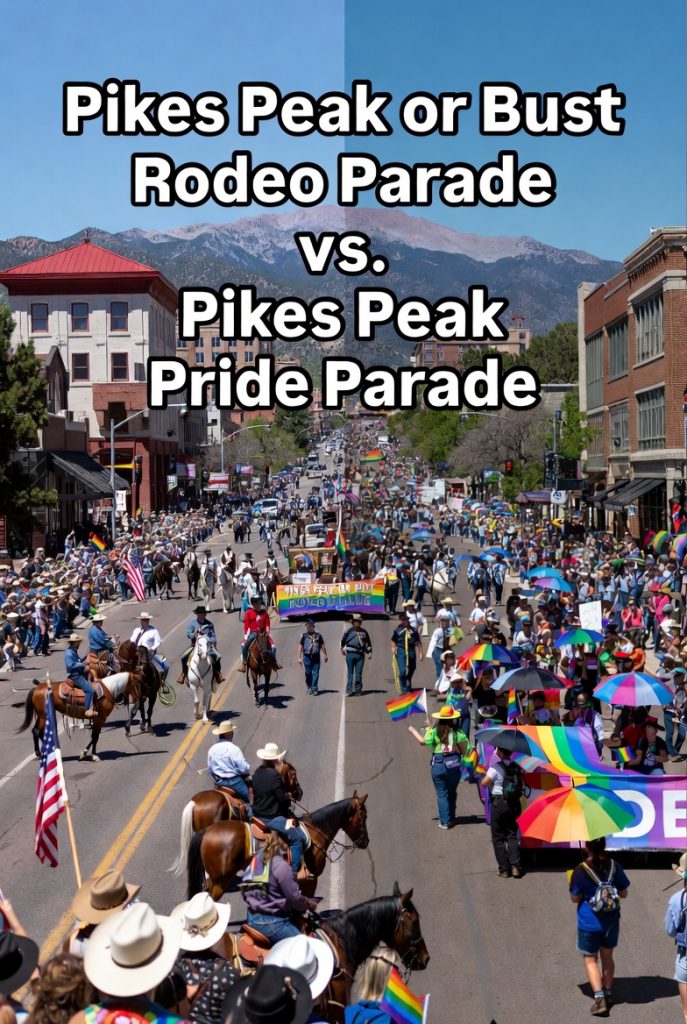
A Cost and Funding Comparison in Colorado Springs. Colorado Springs hosts several free public parades that draw crowds to downtown streets, particularly along Tejon Street. Two notable examples are the traditional Pikes Peak or Bust Rodeo Parade (often tied to Western heritage and the associated rodeo) and the Pikes Peak Pride Parade (part of the annual Pride festival). Both are free for spectators, but their organizational models, public funding, and recent outcomes differ significantly.
- Pikes Peak or Bust Rodeo Parade: A Western-themed procession featuring horses, floats, marching bands, rodeo royalty, and family activities like the Lil’ Cowpokes Stick Horse Races (entry ~$15–20 for kids). It has historically kicked off rodeo week and promotes the Pikes Peak or Bust Rodeo, whose proceeds support local military families. The parade itself has long been free to watch.
- Pikes Peak Pride Parade & Festival: A colorful LGBTQ+ celebration with a parade followed by a multi-day festival featuring vendors, entertainment, and community activities at Alamo Square Park. Both the parade and festival are free and open to the public. Organizers describe it as family-friendly and report drawing tens of thousands of attendees.
Public Funding and Direct Costs Public data on exact total costs (organizational expenses, permits, street closures, police overtime, barricades, etc.) for the parades specifically is limited. Both events use public streets and require city coordination for safety and traffic.
- Pikes Peak or Bust Rodeo Parade: Primarily privately organized and presented (e.g., by O’Donnell & O’Donnell LLP in recent years). It has not received direct city event funding in recent cycles. In 2025, the associated rodeo/parade lost prior recognition-based support amid broader cuts to the city’s Lodgers and Automobile Rental Tax (LART) event funding pool (which dropped from ~$2.4 million disbursed in 2024 to ~$1.6 million for 2025 across fewer recipients).
As of June 19, 2026, organizers canceled the 83rd annual parade (scheduled for July 11) due to inability to secure sufficient private resources, sponsorships, and support “at the level the community deserves.” The related rodeo (July 14–18, 2026) continues with ticket sales.
- Pikes Peak Pride Parade & Festival: Organized by the nonprofit Pikes Peak Pride. The festival (not the parade separately) received city LART funding of $40,000 in one recent year and $60,000 for 2025 (an increase). City officials have noted that such grants often help cover city-provided services like police, fire, and barricades, whose costs are determined by the city rather than organizers.
Organizers have cited economic impact estimates of $1.7–2 million for the event in recent years. The parade itself operates as a free component of the broader festival.
Security, Police, and Indirect Public Costs Both events involve Colorado Springs Police Department (CSPD) coordination for public safety, traffic control, and street closures. Pride organizers have emphasized close collaboration with CSPD and other agencies, especially given the open nature of the event. City commentary around Pride funding has linked portions of the grant to reimbursing or supporting these municipal services.
No publicly available, side-by-side audited figures isolate exact police overtime or total municipal costs for each parade. Pride events have faced heightened scrutiny in funding debates, with some council members and residents questioning the allocation on values or priority grounds. Traditional events like the Pikes Peak or Bust parade/rodeo also compete for limited resources but have relied more on private support. Key Takeaways from Available Data
- Direct city grants: Pride festival received targeted LART funding ($60k in 2025); Pikes Peak or Bust received none in the same cycle and recently canceled its parade due to private-sector shortfalls.
- Economic claims: Pride organizers highlight visitor spending and downtown activity. The Pikes Peak or Bust rodeo has a long track record of charitable fundraising for military families.
- Access model: Both parades remain free to attend. The Pride festival is also free-entry; the Pikes Peak or Bust rodeo is a ticketed event.
- Transparency note: Comprehensive, comparable breakdowns of full event costs (including all public resource usage) are not readily published for either. Broader city event funding faced cuts overall, affecting multiple traditions.
Perspectives in the Community Debates around these events often center on taxpayer priorities, economic returns, inclusivity, and values. Some view Pride funding as support for a growing segment of the community with measurable downtown impact. Others argue that limited public dollars should prioritize longstanding local traditions or question specific allocations amid competing needs. Council discussions have included both support for expanded events and concerns about reflecting “community values.”
Without granular, independently verified cost data for security, logistics, and operations on both sides, direct “cost vs. cost” comparisons remain incomplete. The Pikes Peak or Bust parade’s recent cancellation highlights challenges in sustaining privately funded traditions, while Pride continues with a mix of nonprofit efforts and city support. For the most current details, check official sources: pikespeakorbustparade.com (or rodeo site), pikespeakpride.org, Visit COS, or Colorado Springs city budget documents. Events can evolve yearly based on sponsorships, volunteer support, and municipal decisions.
More Information about: Lodgers and Automobile Rental Tax (LART)
Article discussion