
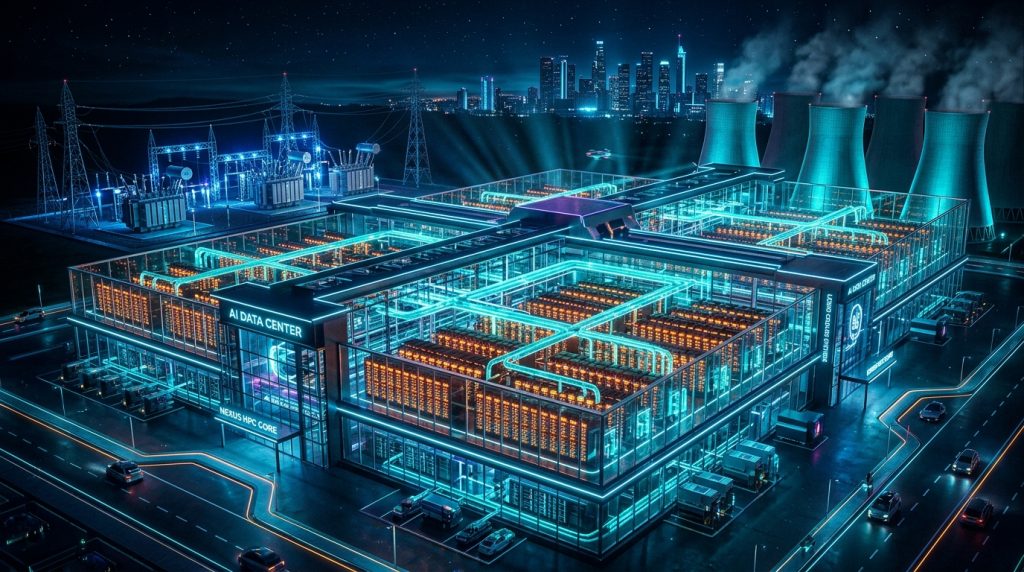
Introduction Artificial Intelligence is transforming our world — from Chat GPT-style chatbots to advanced agentic systems that can act autonomously. But behind every impressive AI breakthrough lies something far less glamorous: enormous AI data centers. These aren’t your average server rooms. Modern AI data centers are industrial-scale “AI factories” that consume as much electricity as small cities, packed with thousands of powerful GPUs working in perfect synchronization. In this post, we’ll break down exactly how AI data centers are built from the ground up and how they actually work once operational. Whether you’re a tech enthusiast, student, or just curious about the hidden backbone of AI, you’ll walk away with a clear understanding of this critical infrastructure. What Makes AI Data Centers Different? Traditional data centers host websites, emails, and cloud storage. AI data centers, however, are purpose-built for massive parallel computing.
They focus on two main tasks:
- Training: Teaching large AI models on huge datasets (extremely compute-intensive).
- Inference: Running trained models to answer queries, generate content, or make decisions (now the majority of energy use).
A single large AI cluster can contain hundreds of thousands of GPUs and draw hundreds of megawatts (MW) of power — sometimes approaching 1 gigawatt (GW) or more. For context, 100 MW can power roughly 80,000–100,000 homes. Step
1: How an AI Data Center Is Built Building an AI data center is a multi-year, multi-billion-dollar engineering project.
Here’s the typical process:
- Site Selection
Companies look for locations with abundant and affordable power, access to high-speed fiber networks, water for cooling, favorable regulations, and land availability. Popular areas include Northern Virginia (the world’s “Data Center Alley”), Texas, and parts of the Midwest and Southeast U.S. - Power Infrastructure
This is often the biggest challenge. AI facilities need dedicated substations, massive transformers, backup generators, and high-voltage connections. Many new projects are partnering with utilities or even exploring on-site nuclear power (small modular reactors) to meet demand. Power is the #1 constraint in 2026. - Cooling Systems
GPUs generate enormous heat. Traditional air cooling works for lower densities but struggles above 30–40 kW per rack.
Modern AI data centers increasingly use liquid cooling technologies:- Direct-to-chip (cold plates on GPUs)
- Rear-door heat exchangers
- Immersion cooling (servers submerged in special fluids)
Liquid cooling can be 40%+ more energy-efficient and supports rack densities of 100 kW or higher.
- Facility Construction
Buildings feature raised floors, modular designs for quick scaling, redundant power and networking paths, and high-security perimeters. Many are built in “pods” or phases so capacity can be added as GPUs become available. - Networking Backbone
Thousands of GPUs must communicate at extremely high speeds using specialized interconnects like InfiniBand or high-bandwidth Ethernet. This creates one giant “supercomputer” rather than isolated servers.
Construction timelines have improved thanks to modular designs, but power and permitting delays remain common. A full hyperscale AI campus can cost $1 billion+ and take 18–36 months for the first phase. Inside the AI Data Center: The Hardware At the heart of these facilities are dense racks of servers loaded with GPUs (primarily from NVIDIA, with competition from AMD and others). A single high-end AI server might contain 8 or more GPUs, each consuming 700–1,000 watts. These racks are networked together into massive clusters — think x AI’s Colossus (hundreds of thousands of GPUs), Microsoft’s Open AI-backed facilities, or Meta’s superclusters planned for 2026.Storage systems hold the enormous datasets, while sophisticated software orchestrates workloads across the entire cluster.
How an AI Data Center Actually Works Once built, here’s the day-to-day operation:
- Power Flow: Electricity from the grid (or on-site generation) is stepped down, conditioned, and distributed to racks with high redundancy (UPS systems and generators ensure zero downtime).
- Compute Flow: During training, data is split across thousands of GPUs that perform matrix calculations in parallel. For inference, smaller groups of GPUs handle user requests at high speed and low latency.
- Cooling Flow: Coolant circulates through servers to absorb heat directly from the chips, then moves to heat exchangers or cooling towers. This process is far more efficient than blowing massive amounts of cold air.
- Management: Advanced orchestration software (often based on Kubernetes) schedules jobs, monitors temperature/power, and optimizes performance. AI itself is increasingly used to manage cooling and energy use dynamically.
The entire system operates like a highly coordinated factory where every component must work flawlessly together.
Key Challenges Facing AI Data Centers in 2026
- Explosive Power Demand: AI is driving a surge in electricity use. Projections show data centers could consume significantly more power in the coming years, prompting concerns about grid strain and higher energy costs.
- Heat and Water Usage: Cooling remains critical, with some facilities using millions of gallons of water daily.
- Sustainability: Companies are investing in renewable energy matching, more efficient liquid cooling, and even restarting nuclear plants to power facilities cleanly.
- Supply Chain: GPUs, transformers, and skilled labor are all in high demand.
Innovations like hybrid air-liquid cooling, better chip efficiency, and on-site power generation are helping address these issues. The Future of AI Infrastructure As AI models grow more capable (and power-hungry), data centers are evolving into true “AI factories.” Expect more gigawatt-scale campuses, greater adoption of liquid cooling, and creative solutions for power — including partnerships with energy companies and advances in nuclear and renewable tech. These facilities aren’t just buildings — they’re the physical foundation enabling the AI revolution. What do you think? Will the energy demands of AI reshape our power grids and environment? Or will technological breakthroughs make AI infrastructure far more efficient?
Drop your thoughts in the comments below!
Article discussion