
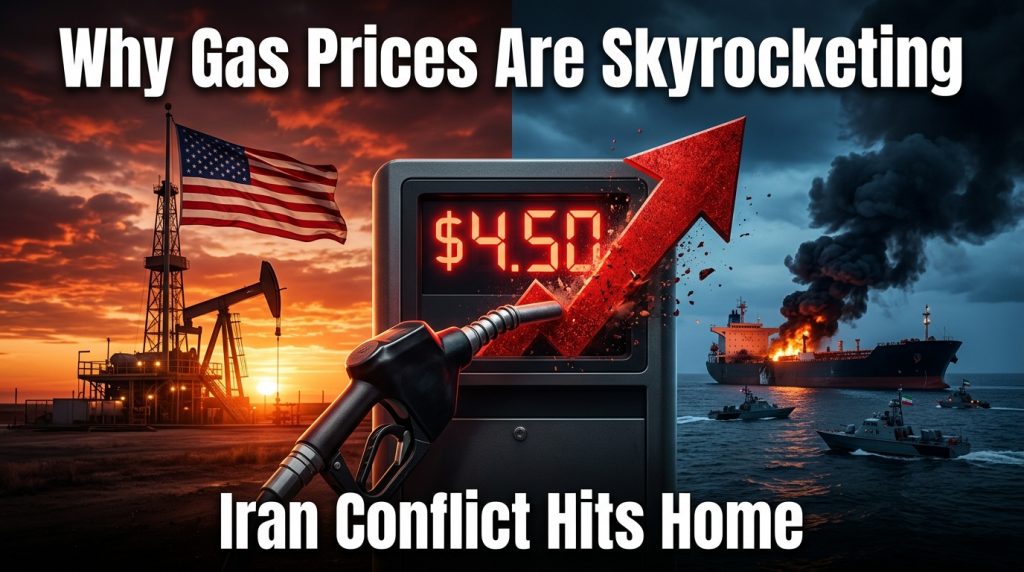
Why You’re Paying More for Gas Right Now Because of the Iran Conflict – Even Though We Don’t Import a Drop of Their Oil (And We’re “Energy Independent”)If you’re filling up your tank this week and wincing at the pump, you’re not alone. As of late April 2026, the national average price for regular gasoline is hovering around $4.02–$4.17 per gallon — roughly $1 higher than before the Iran conflict escalated in late February. In some states like California, it’s pushing past $5. Diesel and jet fuel are up even more. Families are feeling it in their wallets, trucking companies are passing costs to consumers, and inflation worries are creeping back in. But here’s the question everyone is asking: Why is this happening to us? We don’t buy oil from Iran. The U.S. is the world’s largest oil producer. We’re a net exporter of petroleum products. We’re supposed to be “energy independent.” So how is a conflict halfway around the world jacking up our gas prices? Let me break it down simply and clearly — no spin, just the facts about how the global oil machine actually works.
1. Oil Is a Global Commodity — Not “Our Oil” vs. “Their Oil
Oil isn’t like buying apples from your local farm. It’s traded on a worldwide market 24/7. Every barrel — whether it comes out of the ground in Texas, Saudi Arabia, or anywhere else — is priced based on global supply and demand.
- U.S. crude oil (called WTI) and global benchmark (Brent crude from the North Sea) set the tone.
- Traders buy and sell futures contracts on exchanges like the New York Mercantile Exchange (NYMEX) and ICE Futures Europe. These aren’t just paper trades; they reflect real expectations about future supply.
- No single person, company, or country “sets” the price. It’s the market — millions of buyers, sellers, refiners, and speculators reacting in real time.
When something threatens even a small chunk of world supply, prices jump everywhere. That’s exactly what’s happening right now.
2. The Iran Conflict’s Real Weapon:
The Strait of Hormuz Iran doesn’t supply the U.S. with oil (our top sources are Canada, Mexico, Saudi Arabia, and others). But Iran sits right next to the Strait of Hormuz — the narrow waterway that carries about 20% of the world’s traded oil every single day. That’s roughly 21 million barrels passing through it daily from Saudi Arabia, Iraq, UAE, Kuwait, and more. During the conflict:
- Iran has threatened, attacked, and disrupted shipping in the strait.
- Insurance rates for tankers skyrocketed.
- Some vessels turned back.
- Even temporary slowdowns or fears of full closure created a massive “fear premium” in the markets.
Result? Global crude prices spiked (Brent briefly topped $120/barrel earlier and is still elevated around $104–$110). That global price flows straight to American gas stations because our refineries, pipelines, and exporters are plugged into the same market. U.S. companies that produce oil here sell it at the world price. Refineries pay the world price for the mix of crude they process. When the world price goes up, so does the cost of the gasoline you buy — even if every drop was pumped in North Dakota.
3. “Energy Independence”
Doesn’t Mean Price Immunity Yes, the U.S. is energy independent in the most important sense:
- We produce more oil and natural gas than we consume.
- We’re a net exporter of petroleum products (gasoline, diesel, jet fuel).
- The shale revolution made us the #1 producer in the world.
But independence doesn’t isolate us from global shocks. Here’s why:
- We still import millions of barrels of crude every day because our refineries are built for specific types of oil (heavy vs. light). We import some, refine it into products, and export the surplus.
- American producers export crude and products to the highest bidder overseas. If global prices rise, domestic prices rise too — or those barrels would just get shipped abroad.
- Oil is fungible (interchangeable). A disruption anywhere tightens the global pool, and prices adjust everywhere.
Experts across the board — from the U.S. Energy Information Administration to energy analysts — confirm this: Geopolitical events in the Middle East still move U.S. pump prices because the market is global. The Iran conflict proves the “energy independence” slogan has limits when 20% of world supply is at risk in one choke point.
Bottom Line:
This Is How the Real World Works High gas prices right now aren’t because of “Big Oil greed” or some domestic policy failure. They’re the direct result of a foreign conflict disrupting the global oil artery at the Strait of Hormuz. The market is pricing in risk — and American drivers are paying the bill. True long-term relief comes from maximizing American production, building more refineries, expanding pipelines and export terminals, and maintaining strong deterrence so adversaries can’t weaponize energy chokepoints. Diversifying global supply chains helps too, but the U.S. can’t secede from the world oil market overnight. In the meantime, every time you pay more at the pump, remember: It’s not about where our oil comes from — it’s about how the world’s oil flows. And right now, that flow is under threat. What do you think? Drop a comment below — are higher gas prices the price of confronting Iran, or is there more we should be doing at home? Share this post if it helped clear up the confusion. Stay informed. Stay independent.
PatriotsFirstMedia
April 28, 2026
Article discussion